Current Affairs
Death sentence for Hasina sours India-Bangladesh relations
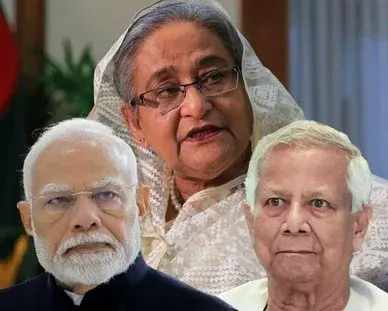
Given the gravity of the issues involved in Sheikh Hasina’s extradition from India and the heightened political sensitivities in both India and Bangladesh, talks across the table are unlikely to yield results now. The aggressive posturing that is grabbing headlines now is meant to satisfy domestic constituencies.
By P.K. Balachandran
Colmbo, November 22 - The thorny question of extraditing former Bangladesh Prime Minister Sheikh Hasina from India to face a death sentence for alleged “crimes against humanity” including “mass murder” is unlikely to be resolved by legal or diplomatic means any time soon given the complexity of the issues and the high stakes involved.
Nevertheless, the two countries are indulging in aggressive posturing for the psychological impact this will have on the opponent and also to keep their domestic constituencies satisfied.
Bangladesh is using its new-found ally, Pakistan, to checkmate India. In recent months, Dhaka and Islamabad have struck security deals aimed at containing India, the regional hegemon. India is not taking kindly to the Bangladesh-Pakistan line up as Pakistan is a veritable red rag for it.
Therefore, a peaceful and amicable resolution of the Hasina affair can be ruled out, unless Bangladesh allows Hasina to live in India under conditions similar to those under which China has tolerated the presence of the Tibetan rebel leader, the Dalai Lama, in India.
But that too is not in the realm of possibility now since Hasina has generated intense political opposition in post-revolutionary Bangladesh.
Bangladesh’s National Security Adviser Khalilur Rahman was in Delhi on November 19 to participate in the Colombo Security Conclave (CSC) at the invitation of the Indian National Security Adviser Ajit Doval. The two had met a day before the conclave started, but no deal was struck. However, Rahman invited Doval to Bangladesh, which indicates that the process of finding a negotiated solution is on.
Issues at Stake
A key ingredient in the Hasina affair is that successive Indian governments and Sheikh Hasina’s family have had a very close relationship from the days of the Bangladesh liberation struggle till Hasina’s ouster in July -August 2024. They have helped each other in multiple ways in security, political and economic matters.
In the backdrop of the developing tense scenario in Bangladesh, India feels the need to use Hasina, a tried and tested ally, to reclaim lost political and strategic ground in Bangladesh. If she is sent back now, she will be executed by the current regime, mainly due to the fear that if alive, she could revive her party, the Awami League, which had spearheaded the country’s independence movement. And if she recaptures power, she could again rule Bangladesh with Indian backing.
The caretaker government led by Prof. Muhammad Yunus has banned the activities of Hasina’s Awami League, dubbing it as “fascist”.
India has indirectly said that it wants the ban lifted. In a statement following the sentencing of Hasina by the Bangladesh International Crimes Tribunal (ICT) on Monday, the Indian External Affairs Ministry called for a “free, fair, credible, and inclusive” Bangladesh. The term “inclusive” alludes to the inclusion of the Awami League in the February 2026 parliamentary elections.
Bangladesh’s current government headed by Dr. Yunus is only an unelected caretaker. And there is a widespread belief that it lacks the legitimacy needed to take critical decisions like executing a former Prime Minister and head of the country’s oldest and the largest political party.
Legal Loophole in Extradition Treaty
On Tuesday, a day after the verdict, Bangladesh’s Ministry of Foreign Affairs cited the 2013 Bangladesh-India extradition agreement to say that India has a “obligatory responsibility” to ensure Hasina’s return to Bangladesh to enable Dhaka to carry out the death sentence. But according to The Times of Bangladesh, no formal diplomatic demand has yet been made, which casts doubt on the seriousness of Dhaka’s stand.
The hint is that Bangladesh is only making a show of seeking extradition to please its domestic constituency ahead of the February elections in which its political allies have to win on an anti-Hasina platform. The Foreign Ministry had made out a political demand and not a legal one when it said that it would be “a highly unfriendly act and a disregard for justice for India to continue to provide Hasina refuge.”
Dhaka knows that India could use Article 6 which of the 2013 extradition treaty which says that “extradition may be refused if the offence for which it is requested is an offence of a political character.”
Bangladesh officially maintains that all legal norms were followed in the trial. But human rights groups do not agree. In her statement, Amnesty International’s Secretary General, Agnès Callamard, said – “Those individually responsible for the egregious violations and the allegations of crimes against humanity that took place during the student-led protests in July and August 2024 must be investigated and prosecuted in fair trials. However, this trial and sentence is neither fair nor just. Victims need justice and accountability.”
She further said – “The death penalty compounds human rights violations. It’s the ultimate cruel, degrading and inhuman punishment and has no place in any justice process.”
UN Human Rights Spokesperson Ravina Shamdasani said – “While we were not privy to the conduct of this trial, we have consistently advocated for all accountability proceedings – especially on charges of international crimes – to unquestionably meet international standards of due process and fair trial. This is particularly vital when, as was the case here, the trials have been conducted in absentia and led to a capital punishment sentence. We also regret the imposition of the death penalty, which we oppose in all circumstances.”
Writing in Eurasia Review, the noted expert on Bangladesh, Subir Bhaumik, said-“In absentia trials always provide limited opportunity for defence, especially when the accused are not allowed to appoint their own defence team. Hasina had to do with an ICT-appointed defence lawyer who neither sought adjournment to buy time to carefully organise the defence nor produced a single defence witness in the five weeks of trial after the chargesheet was submitted. Most lawyers that this writer spoke to in Bangladesh said this was a kangaroo court and that vendetta, not justice, topped the agenda.”
The Catholic Bishops Conference of Bangladesh said in a statement that Hasina’s trial was “one sided” as she was not given proper legal representation.
Hasina Ready to Face Hague Court
In her statement after Monday’s verdict, Hasina said –“ The verdict announced against me has been made by a rigged tribunal established and presided over by an unelected government with no democratic mandate.”
Hasina further said, she is “ready to face her accusers in a proper tribunal where the evidence can be weighed and tested fairly.” She challenged the interim government to bring these charges before the International Criminal Court (ICC) at the Hague.
“But the interim government will not accept this challenge, because it knows that the ICC would acquit me. The interim government also fears that the ICC would scrutinise its own record of human rights breaches in office,” Hasina said.
“Our government was democratically elected by the people, and we were accountable to them. Dr Yunus, on the other hand, came to power unconstitutionally, and with the support of extremist elements. Under his rule, every protest — from students, garment workers, doctors, nurses, and teachers to professionals — has been met with suppression, some of it brutal. Peaceful demonstrators have been shot and killed. Journalists who attempt to report these incidents face harassment and torture,” she charged.
Impact on Indo-Bangla Relations
Since the current Bangladesh government is committed to destroying the Awami League, India -Bangladesh relations will be tense for the foreseeable future. The two sides are likely to play a cat and mouse game rather than force the issue by going to war or imposing crippling sanctions.
Some observers say that if the Bangladesh Nationalist Party (BNP) comes to power through the February 2026 elections and if it expresses a wish to restore normal political life with no political party being declared untouchable, Hasina would herself want to go back to Bangladesh. Earlier in the 1990s, she had come out of exile and entered Bangladesh politics to fight a military ruler in cooperation with other parties.
According to Michael Kugelman, a US-based South Asia analyst, Hasina’s political legacy and the future of her Awami League cannot be written off completely. After all, the Awami League had spearheaded the Bangladesh liberation movement and was the single largest political party till Hasina was overthrown by a student agitation in 2024.
Dhaka-Islamabad Military Nexus
Be that as it may, there is a more important factor as far as India is concerned - the growing Dhaka-Islamabad military nexus. Impressed by Pakistan’s evolving military professionalism, its operational credibility, and its proven ability to withstand Indian hostility, the Yunus regime is assiduously cultivating the Pakistan military.
Dr. Sohini Bose of the Observer Research Foundation in New Delhi says that on January 14, a Bangladeshi military delegation led by the Principal Staff Officer of the Bangladesh Armed Forces Division, Lt.Gen. S.M. Kamrul Hasan, met Gen. Asim Munir, Pakistan’s Army Chief, Gen. Sahir Shamshad Mirza, Chairman of the Joint Chiefs of Staff Committee, and Air Force Chief Marshal Zaheer Ahmed Baber Sidhu. Regional security dynamics, the scope for joint military exercises, training programmes, and defence trade were discussed.
Later in the month, a delegation led by Pakistan’s Inter-Services Intelligence (ISI) Director General, Maj. Gen. Shahid Amir Afsar, visited Dhaka. In February, Bangladeshi warship BNS Samudra Joy participated in a naval exercise, Aman-2. At the exercise the Bangladesh Navy Chief, Admiral Mohammad Hasan, said - "Land divides but sea unites" referring to the thousands of miles of Indian land dividing Bangladesh and Pakistan.
Dhaka has also shown interest in acquiring JF-17 Thunder fighter jets from Pakistan to upgrade its military assets under its “Forces Goal 2030”, thus signalling a potential trilateral defence partnership between China, Pakistan and Bangladesh.
Bangladesh Air Base near Chicken Neck
According to Dr. Bose, Bangladesh has invited Chinese investment to develop an airbase at Lalmonirhat, near India’s strategically sensitive Siliguri Corridor, popularly known as the “Chicken Neck.” This 22 km corridor connects the politically fragile Northeastern States of India to the rest of India. An airbase in Lalmunirhat would place China and Pakistan too close to the India, China, Bangladesh trijunction.
Then there are threatening comments aired by influential Bangladeshis which set off alarm bells in India.
Maj. Gen. (Retd) ALM Fazlur Rahman, a close aide of Yunus and chairman of the National Independent Commission investigating the 2009 Bangladesh Rifles revolt, had said, “If India attacks Pakistan, Bangladesh should occupy the seven States of Northeastern India. I think it is necessary to start discussions with China on a joint military arrangement in this regard."
Witing in www.bdmilitary.com Khaled Ahmed, a former intelligence analyst and a military expert living in the Netherlands, advocated covert action to seize Hasina, or even to eliminate her. He also advocated terror strikes in India.
But Dr Shahab Enam Khan, Professor of International Relations at Jahangirnagar University in Dhaka and a noted China policy expert voiced opposition to disruptive action. He said, “Stability along the Siliguri Corridor is in everyone’s interest including ours.”
There is belligerent talk in India too, though none in authority is guilty of that. An article in the right-wing nationalist magazine “Swarajya” suggested that India should seize Rangpur district and the Chittagong Hill Tracts in Bangladesh to settle the “persecuted” Hindu, Christian and Buddhist minorities in Muslim-majority Bangladesh.
India Beefs Up Defences
India is not taking chances. As per media reports, India's military has reinforced the eastern frontier by establishing two garrisons at strategic points around the Chicken Neck, at Chopra in West Bengal, and Dhubri in Assam. These protect the highways, rail lines, fuel pipelines and digital networks which pass through the Chicken Neck.
The Chopra base hosts expanded communications infrastructure with armour and troops on stand- by. Dhubri, overlooking the Brahmaputra river basin, has boosted riverine surveillance and night-watch capability. Wider bridges have been built over the Teesta river to avoid choke points, alternate rail lines have been laid to reduce the corridor’s susceptibility to blockades.
The Indian Air Force staged one of its largest-ever air shows in the northeastern State of Assam on November 9. This came ahead of seven days of air force exercises across northeast India.
Commenting on these, retired Lt. Gen. Utpal Bhattacharya told the German agency DW, "Sometimes these are routine exercises, sometimes strategic signalling. But intentions can change overnight. Today's friend can become tomorrow's adversary if trust erodes."
However, neither government wants to take any action that would precipitate an armed conflict, given the geographic and economic ties between India and Bangladesh. India is Bangladesh’s biggest trading partner.
Some in India hope that a government with a people’s mandate will emerge after the February 2026 parliamentary elections in Bangladesh, with which New Delhi could have realistic and result-oriented talks on all sensitive issues.
In sum, in the foreseeable future, both India and Bangladesh could be expected to maintain official restraint, even as they indulge in some belligerent posturing to satisfy their domestic constituencies.
END
RELATED NEWS
View all

Current Affairs
Sri Lankan Presidential pardons- the good and the bad
Sep 11, 2026
Current Affairs
The pros and cons of joining BRICS- the dilemma of Pakistan and Bangladesh
Sep 09, 2026
Current Affairs
Disaster in Nepal gets embroiled in geopolitics.
Sep 08, 2026
Current Affairs
Why Mecca Pact, and what does it imply for its members, Israel and India?
Aug 18, 2026