Politics by Vishvanath, Cover Story
Disasters, challenges, opportunities and pitfalls
By Vishvanath
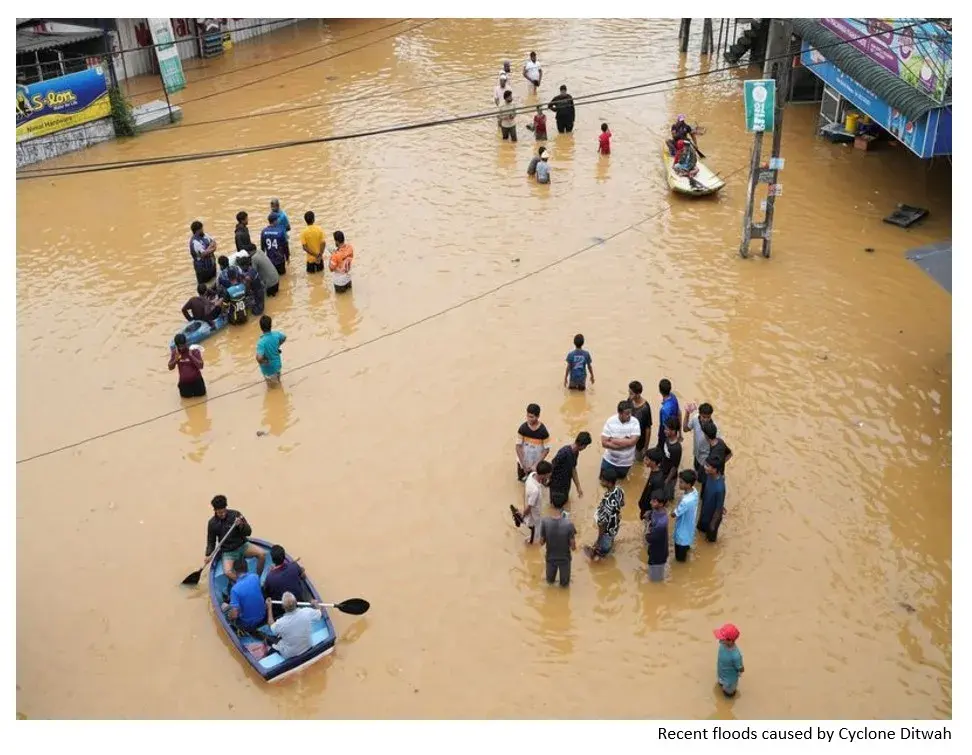
It is said that nothing is so certain as the unexpected in politics, which is full of surprises, as in the board game, Snakes and Ladders. No sooner had the NPP government boasted that the state coffers were overflowing than Cyclone Ditwah struck ferociously, devastating many parts of the country and dealing a heavy blow to the economy. It is too early to calculate the economic cost of the recent natural disasters that shook the country, but Commissioner General of Essential Services Prabath Chandrakeerthi has said relief and rebuilding programs will cost about USD 6-7 billion amounting to about 3-5% of GDP—approximately three times the damage caused by the 2004 Boxing Day tsunami, according to media reports quoting some experts.
The government is planning to hold a donors’ conference early next year to raise funds for post-disaster rebuilding. There has been an influx of relief materials from other countries, but donations in foreign currency have been coming in dribs and drabs. There’s the rub. The Finance Ministry announced on December 14 that the value of foreign currency donations stood at USD 4.1 million, and, overall, the ‘Rebuilding Sri Lanka’ fund, had received Rs. 3,421 million. Secretary to the Ministry of Finance, Planning and Economic Development, Dr. Harshana Suriyapperuma said the government was hopeful that the inflow of foreign currency contributions would continue.
There is hardly anything that the government and the Opposition do not clash on. They are viewing post-disaster foreign assistance through different political lenses. While the government is trying to make assistance from other countries out to be an indication of its international recognition, the Opposition is of the view that foreign aid was not sufficient at all. Leader of Pivithuru Hela Urumaya and former Cabinet Minister Udaya Gamanpila has gone on record as saying that the Chandrika Kumaratunga government received aid, amounting to 87% of the total cost of post-tsunami rebuilding in 2005, but the funds the incumbent JVP-led NPP had been able raise so far was still below 1% of the projected cost of rebuilding.
Deputy Minister of Finance and Planning Dr. Anil Jayantha Fernando has been quoted by Reuters as saying that the government expects the economy to expand at the rate of 5% despite the blows it has suffered from the disaster and the staggering cost of rebuilding. What one gathers from his forecast is that the government has pinned its hopes on foreign governments and international funding agencies for the country’s recovery efforts. Dr. Fernando has said that with quick response and support from agencies and the existing development programs, the government thinks the growth will not be hampered extensively. “Rather, it would increase; maybe new investments come for reconstruction, the repair of these infrastructures and all those things. In a way, even from a technical perspective, it will not slow down, it will go up further.” He has said growth this year will exceed 5%, and this is higher than the Central Bank’s 4.5% projection, based on numbers in the first three quarters of the year. He expects similar growth next year too. The IMF has predicted 3.5% in 2025 and 3.1% next year, Reuters has pointed out. Dr. Fernando seems to believe that repairs to damaged houses, the restoration of infrastructure such as roads and railways, and rebuilding livelihoods, will require a diversion of funds from other areas, the utilization of a part of tax revenue and more international support.
Meanwhile, the Parliament is expected to approve Rs 500 billion (approximately USD 1.6 billion) in supplementary spending, funded partly through the reallocation of ministry budgets. An additional Rs. 1.4 trillion (or USD 4.6 billion) has been earmarked for capital expenditure in 2026, partly to support post-cyclone reconstruction efforts. At the time of writing, a Supplementary Estimate of Rs. 500 billion was to be presented to the Parliament for post-disaster relief and reconstruction. At the request of the Prime Minister Dr. Harini Amarauriya, and in accordance with the provisions of Standing Orders 16 of Parliament, it was decided to convene the Parliament on Thursday (18) and Friday (19).
Post-disaster relief and rebuilding programs usually do not make governments popular. They draw more criticism than praise and leave many victims resentful. This is due to various factors including deficiencies in relief distribution mechanisms, corruption, lack of funds and the unfulfilled aspirations of the disaster victims. The relocation of landslide survivors in itself will be a huge political problem, with most of them demanding better land and complaining of the amounts of funds disbursed as compensation. The government has pledged Rs. 5 million each per family for the acquisition of land and the construction of a house. However, President Anura Kumara Dissanayake has said in a circular issued by the Ministry of Finance that Rs. 5 million for a plot of land will be given if the state cannot provide land to the victims. So, the government will go all out to make state land available for the reconstruction of houses, and the beneficiaries are likely to be left without a choice. There have been numerous complaints about the locations of the houses built for the tsunami victims. Clashes between disaster victims and state officials engaged in relief distribution have already been reported from various parts of the country.
Leader of the United Republican Front and former Cabinet Minister Patali Champika has argued in a television interview that in Sri Lanka, no government that faced mega crises won subsequent elections. He has cited the fate that befell the UNP-led Yahapalana government and the SLPP-UNP government led by President Ranil Wickremesinghe, following the Easter Sunday terror attacks, and the handling of the economic crisis, respectively. It is also worth recalling that the SLFP-led UPFA government, which was in power during the 2004 tsunami disaster, almost lost the 2005 presidential election. Its candidate Mahinda Rajapaksa scraped through that contest thanks to an election boycott declared by the LTTE, leaving the UNP’s presidential candidate at a disadvantage. President Rajapaksa had to fight quite a battle to secure a second term in 2010 despite his political leadership for defeating the LTTE militarily in mid-2009 and ending the Eelam war. Ranawaka recalled the defeat of war-winning British Prime Minister Winston Churchill in the first general election after the end of World War II.
So, on the political front, the biggest challenge for the NPP government, which has had to grapple with the fallout from one of the worst disasters in Sri Lanka, is to make use of the opportunities to shore up its electoral prospects while avoiding pitfalls.
RELATED NEWS
View all
Politics by Vishvanath
Has 22A become the govt.'s Catch-22?
Aug 27, 2026
Politics by Vishvanath
22nd Amendment: A huge political gamble for govt.
Aug 21, 2026
Politics by Vishvanath
Move to raise retirement ages of judges: Options before govt.
Aug 05, 2026

Politics by Vishvanath
‘Cockroach’ uprising and echoes of Aragalaya
Jul 26, 2026