Politics by Vishvanath, Cover Story
Do-or-die battle in Colombo next Wednesday
By Vishvanath
Hardly a day passes without a mega issue on the political front in this country. The NPP government and the Opposition are preparing themselves for D-Day on Wednesday, when a fresh vote is scheduled to be taken on the budget of the Colombo Municipal Council (CMC).
The joint Opposition, led by the SJB, defeated the CMC budget on Dec. 22; it received 60 votes as opposed to the NPP’s 57. This is not something the NPP expected. In fact, it was a comedown for the government. President Anura Kumara Dissanayake himself carried out the NPP’s campaign to secure the passage of its CMC budget, and the Opposition has claimed that the President hosted a dinner for the NPP councilors and the Opposition members supporting the NPP. The defeat of the NPP’s budget in the CMC has thus become a reflection on President Dissanayake himself. He is therefore bound to do everything possible to have the council budget passed on Wednesday. The Opposition is determined to make the NPP suffer another defeat.
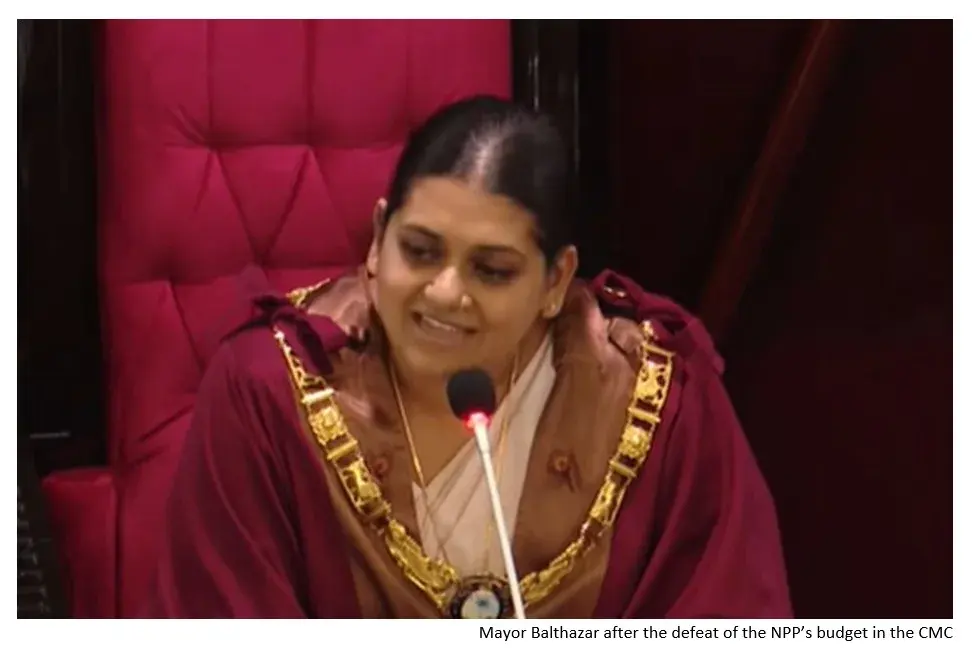
The budget defeat left Colombo Mayor Vraie Cally Balthazar (NPP) deeply affected. Addressing the council meeting, in a voice choked with emotion, she said what had been defeated was not an NPP budget but a budget of conscience, and the people of Colombo deserved better. The Opposition dismissed her remarks as mere rhetoric aimed at covering the NPP’s humiliating defeat.
In June 2025, Balthazaar became the Colombo Mayor in a secret ballot by obtaining 61 votes while Riza Zarook of the SJB received 54 votes, in a tight contest. In the CMC elections held in May 2025, the NPP secured 48 seats, the SJB 29 seats, the UNP 13 seats, the SLPP five seats, Sri Lanka Muslim Congress four seats, Independent Group No. three seats, the Sarvajana Balaya two seats, and the UPFA two seats. Two votes were rejected, according to Commissioner of the Department of Local Government of the Western Province, Sarangika Jayasundara, who presided over the voting. She came under fire for holding a secret ballot, which, the Opposition claimed, was advantageous to the NPP, which had resorted to horse trading and wanted the identities of the Opposition councilors kept secret. The Opposition also did likewise, making various promises to the councilors straddling the fence.
Stakes are extremely high for the NPP—as well as the Opposition—in Wednesday’s budget vote, which I cannot afford to lose for a second time. Not that the NPP administration will collapse in such an eventuality; the local government laws provide for the continuation of any local administration for two years despite the defeat of the budget of a council; thereafter the council is placed under a Special Commissioner if its budget is defeated once again.
The CMC is the jewel in the NPP’s crown. This premier council used to be a UNP stronghold. The UNP would secure its control even after suffering heavy defeats in national elections. But the NPP made history by bagging the CMC last May by obtaining a plurality and winning over 13 Opposition members thereafter to seize control of the council. However, it is now struggling to retain its majority as evident from the defeat of its budget.
The NPP has failed to have its budgets passed in a considerable number of other councils across the country. In some councils, like the Horana UC, its members went to the extent of meeting in advance of the start time, declaring their budgets passed and dispersing before the arrival of the Opposition councilors. The Opposition has been protesting against such meetings and threatening legal action against the head of the local councils and their secretaries. The SJB has alleged that in the Negombo MC, the NPP arbitrarily declared its budget passed without a vote, and in the Galle MC, the vote count was manipulated in favor of the NPP; the Opposition prevented the council secretary from leaving the auditorium and forcibly took another vote on the budget, mustered a majority and declared the budget defeated amid protests from the NPP members, who walked out.
The SJB has told the NPP that it is now in control of the CMC, as evident from the outcome of the budget vote, and the government should come to terms with that fact and hand over the reins of the council to the Opposition. However, the defeat of a budget does not lead to the collapse of a local council administration.
Budget defeats are not uncommon in local councils characterized by problematic group dynamics and intraparty rivalries, which spin out of control, with some councilors even defying their party leaders’ orders. However, it is too early for a political party that has won a two-thirds majority in the parliament to face such problems and fail to secure majorities for its budgets. Its failure portends trouble for it. To make matters worse, the NPP has suffered a string of defeats in cooperative society elections in many parts of the country. Political parties are not represented in these elections, but they back candidates openly, and the NPP has gone so far as to put up posters in some areas in support of its candidates. After all, before last year’s presidential election, the NPP flaunted its victories in the cooperative society elections as an indication of a swing for it in subsequent elections. Its prediction came true. Now, the Opposition is using the NPP’s argument to have the public believe that the outcome of the cooperative society elections show that the government is losing ground at the grassroots level.
Wednesday’s high-stake budget vote in the CMC will assume the same importance as a by-election, with the government and the Opposition going all out to win it. The NPP will leave no stone unturned in its efforts to secure the passage of its budget, and the Opposition will make a similar effort to retain its 60 votes. The NPP is under the microscope and will therefore have to play a straight bat.
RELATED NEWS
View all
Politics by Vishvanath
Has 22A become the govt.'s Catch-22?
Aug 27, 2026
Politics by Vishvanath
22nd Amendment: A huge political gamble for govt.
Aug 21, 2026
Politics by Vishvanath
Move to raise retirement ages of judges: Options before govt.
Aug 05, 2026
Politics by Vishvanath
‘Cockroach’ uprising and echoes of Aragalaya
Jul 26, 2026