Politics by Vishvanath, Cover Story
Easter Sunday attacks, probes, debates and confusion
By Vishvanath
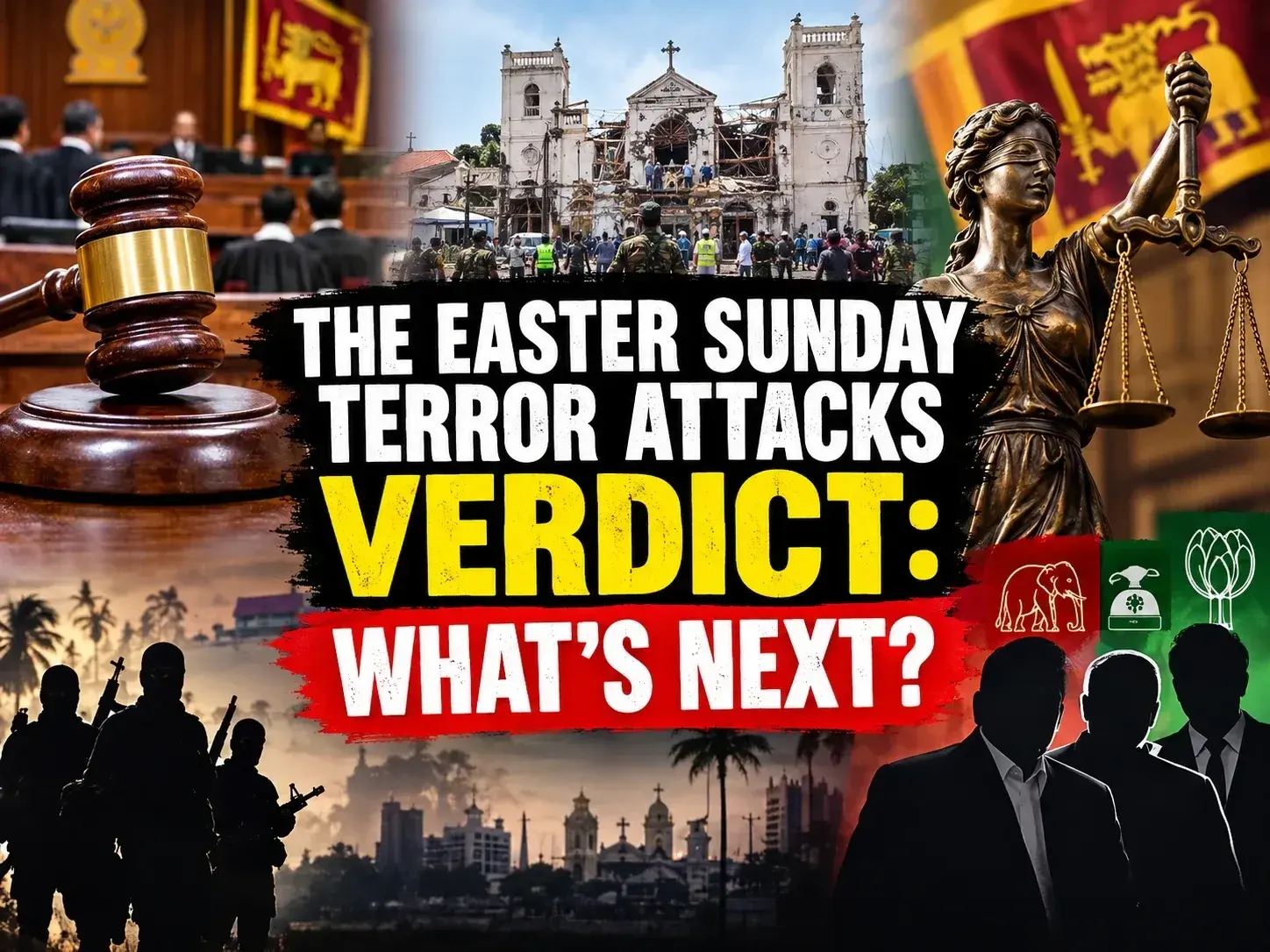
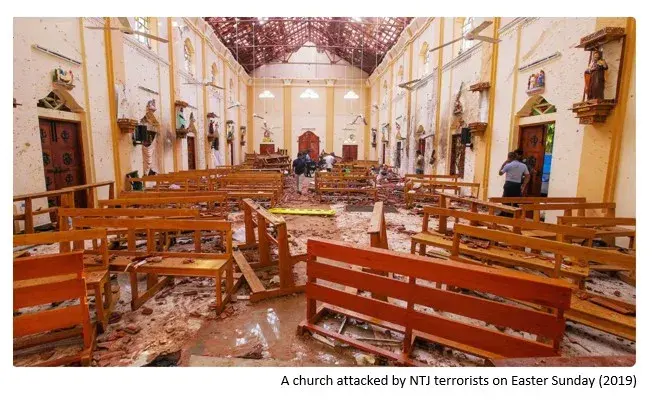
There seems to be no end to debates on, and investigations into, the 2019 Easter Sunday terror attacks, which killed 277 people and injured more than 400 others, according to the police. They and conspiracy theories about the carnage have obfuscated the main issue and left the public confused.
The Parliament debated the Easter Sunday terror attacks again on Wednesday (09). Minister of Public Security Ananda Wijepala made a special statement in the House, claiming, among others, that TMVP leader and former State Minister Sivanesathurai Chandrakanthan, alias ‘Pilleyan’, had been aware of the terror attacks while he was in the Batticaloa prison. Pilleyan was arrested in April 2025 over the abduction and disappearance of Eastern University Vice Chancellor Prof. S. Raveendranath in 2006.
Former Minister Udaya Gammanpila has gone on record as saying that the government is trying to implicate Pilleyan in the Easter Sunday attacks as there has been no progress in the latest investigation into the carnage although President Anura Kumara Dissanayake had vowed to reveal the truth about the terror masterminds before sixth anniversary of the carnage, on April 21 2025.
Colombo Archbishop Cardinal Malcolm Ranjith has found fault with the incumbent government for failing to fulfil its promise to bring the true perpetrators of the Easter Sunday attacks to justice and accused the Attorney General Department officials of ‘dancing to the tune of their political masters’.
Speaking at a religious ceremony at Kochchikade St. Anthony’s Church in Colombo, last month, Cardinal Ranjith expressed his disappointment at the government’s failure to fulfil its promises, saying, “I am still concerned about the government’s failure to honour its commitment regarding the investigation into the attacks.” It is being claimed in political circles that the Cardinal’s rebuke may have been the reason why Public Affairs Minister Wijepala made the aforementioned statement in the parliament on Wednesday.
SJB General Secretary and MP Ranjith Madduma Bandara, responding to Minister Wijepala on Wednesday, said the government had found nothing new about the Easter Sunday attacks. He said that while testifying before the Presidential Commission of Inquiry (PCoI), which probed the terror attacks, a senior state official had written on a piece of paper, the name of the person he considered the mastermind and given it to the commissioners. What was written on that slip of paper would have helped identify the mastermind, he said.
SJB MP Mujibur Rahman tabled in the parliament several documents including the report of the Imam Committee on a claim made in a Channel 4 programme on the Easter Sunday attacks that military intelligence had links to the National Thowheed Jamaath (NTJ), which carried out the terrorist bombings. He said those reports would be useful for ongoing investigations.
References to investigations conducted by committees and commissions into the Easter Sunday attacks and arguments based on them must be really confusing to those who have not been able to follow them and developments related to them closely since 2019. So, the chronology of those investigations may help dispel the confusion surrounding them, to some extent.
The Malalgoda Committee: The first presidential probe into the Easter Sunday terror attacks on April 21, 2019 was ordered the following day itself. Upon his return from overseas, the then President Maithripala Sirisena appointed a presidential committee headed by Judge Vijith Malalgoda to probe the bombings that killed around 277 people (including eight suicide bombers) and wounded more than 400 people in three churches and three hotels in Sri Lanka, according to the Police Headquarters. The appointment of that committee was seen in some quarters as an attempt by President Sirisena to deflect blame for his failure to prevent the attacks. The committee submitted its report on June 10, 2019 to President Sirisena, who did not make it public, providing grist to his political opponents’ mill and much to the resentment of the seekers of justice.
Parliamentary Select Committee: Forty Members of Parliament representing the UNP, the UPFA, ITAK and JVP presented a resolution in Parliament requesting the appointment of a Parliamentary Select Committee (PSC) and it was passed without a division on May 22 2019. The PSC held 24 sittings from May to October 2019 and heard evidence from 55 persons.
The PSC consisted of J. M. Ananda Kumarasiri, Deputy Speaker and Chair of the Committee Rauff Hakeem, Ravi Karunanayake, Rajitha Senaratne Hon. Sarath Fonseka M. A. Sumanthiran, Nalinda Jayathissa, Ashu Marasinghe, and Jayampathy Wickramaratne. About 60 persons, including President Sirisena and Prime Minister Wickremesinghe testified before the PSC, which submitted its report to the parliament on Oct. 23, 2019. The document has since been in the public domain.
One of the key observations made by the PSC gave rise to the claim that the terror attacks may have been aimed at facilitating a regime change in 2019. The report says, among other things: “The PSC makes a very serious finding in terms of the status of the state intelligence apparatus, where intelligence information known to a few was not shared with relevant parties. The PSC also observes that further investigations will be needed to understand whether those with vested interests did not act on intelligence so as to create chaos and instil fear and uncertainty in the country in the lead up to the Presidential Election to be held later in the year. Such a situation would then lead to the call for a change of regime to contain such acts of terrorism. Coincidently or not so coincidentally, the security situation and fear would be unleashed months away from the Presidential Election. The PSC also notes that this occurred in the context of changes in the leadership in the Sri Lankan Army and DMI [Directorate of Military Intelligence] in 2019. These are extremely serious observations that can impact the democratic governance, electoral processes and security of Sri Lanka and must require urgent attention.”
It was this observation that gave rise to speculation that the attacks may have been engineered to catapult national security to the centre stage of politics prior to the 2019 presidential election in favour of the SLPP’s presidential candidate, Gotabaya Rajapaksa, and a section of the military intelligence may have been behind the attacks.
Presidential Commission of Inquiry: On September 22, President Sirisena appointed a Presidential Commission of Inquiry (PCoI) to investigate the terror attacks. By the time the Easter Sunday carnage occurred, President Sirisena and the UNP had fallen out due to the former’s abortive attempt to sack Prime Minister Wickremesinghe and form a government with Mahinda Rajapaksa as the Prime Minister in late 2018. Therefore, it is believed that Sirisena appointed the PCoI because he sensed that the PSC, dominated by the UNP-led UNF, would submit a damning report, holding him accountable for the lapses that had led to the terror strikes.
The PCoI recorded evidence from 457 witnesses and on Feb. 01, 2021, presented its report to the then President Gotabaya Rajapaksa. It held a number of people including Sirisena and Wickremesinghe as the people responsible for the failure to prevent the Easter attacks.
Most of the key recommendations of the PCoI have not been implemented, and Archbishop of Colombo Malcolm Cardinal Ranjith and others who are seeking justice for the victims of terror attacks faulted the SLPP government for its failure to carry them out.
Imam Committee: President Ranil Wickremesinghe appointed a committee led by retired Supreme Court Justice S. I. Imam, to investigate claims made by a former aide to Pilleayn, Azad Moulana, in a Channel 4 documentary, of collusion between the Sri Lankan intelligence services and the terror suspects involved in the Easter Sunday bombings. It handed over its report to President Wickremesinghe on June 25, 2024.
Alwis Committee: President Wickremesinghe appointed another committee chaired by retired Justice A. N.J. de Alwis to probe potential failure on the part of the Police and State Intelligence Services to prevent the Easter Sunday attacks. The committee handed over its report to President Wickremesinghe on September 14, 2024, exactly one week before the election of incumbent President, Anura Kumara Dissanayake.
The current Opposition accused President Dissanayake of having shelved the Imam and Alwis committee reports. Former Minister Udaya Gammapila released them at two different press conferences late last year. The Archbishop of Colombo as well as the Catholic Church rejected the findings of the two committees. Addressing the media, he said in October 2024 that he and the church recognized only the report by the Presidential Commission of Inquiry (PCoI) into the terror attacks.
The current administration has launched a fresh investigation into the Easter Sunday bombings, and claimed that it is making good progress. (Next search for the masterminds.)
RELATED NEWS
View all
Politics by Vishvanath
Has 22A become the govt.'s Catch-22?
Aug 27, 2026
Politics by Vishvanath
22nd Amendment: A huge political gamble for govt.
Aug 21, 2026
Politics by Vishvanath
Move to raise retirement ages of judges: Options before govt.
Aug 05, 2026
Politics by Vishvanath
‘Cockroach’ uprising and echoes of Aragalaya
Jul 26, 2026