Politics by Vishvanath, Cover Story
Easter Sunday terror attacks: Search for masterminds
By Vishvanath
The NTJ (National Thowheed Jamaath) terror attacks, on April 21, 2019, turned out to be a one-off, with its leader Zahran Hashim himself carrying out a suicide bomb attacks in the Shangri-La hotel, Colombo, on April 21, 2019. The entire terror network collapsed like a house of cards within less than 72 hours, in the aftermath of the carnage, and the NTJ threat was effectively neutralized.
Investigations have revealed that the NTJ had painstakingly built a terror network for years before carrying out the Easter Sunday attacks, and this fact led to speculation that there would have been no need for such planning for a one-off attack, and the NTJ had a long-term mission and a bigger goal. A sustained campaign to indoctrinate children, stockpiling of arms and explosives, and the establishment of a terror network complete with training centres suggest that the NTJ and/or its handlers had a long-term strategy.
The Presidential Commission of Inquiry (PCoI), which probed the terror strikes, sought to put the matter to rest by arguing that circumstances had made the NTJ change its original plan. The Commission report says:
“The original plan of Zahran was to attack the Kandy Perahera. But it was advanced due to the recovery of explosives from Wanathawilluwa and international factors. IS was losing ground in Syria and Iraq and called on its faithful to launch attacks. He was also concerned that the law enforcement authorities may apprehend him soon.”
But the question is whether Zahran would have made such elaborate preparations for a single attack on the Kandy Perahera or any other target.
The PCoI explanation did not have the desired effect, and conspiracy theories persisted, receiving a mega boost from the then Attorney General’s claim during a conversation with Archbishop of Colombo Cardinal Malcolm Ranjith that the terror attacks had been the result of a grand conspiracy. Another factor that gave the conspiracy theories a big fillip was an observation by the Parliamentary Select Committee (PSC) on the Easter Sunday terror attacks. The PSC report said, among other things:
“The PSC makes a very serious finding in terms of the status of the state intelligence apparatus, where intelligence information known to a few was not shared with relevant parties. The PSC also observes that further investigations will be needed to understand whether those with vested interests did not act on intelligence so as to create chaos and instil fear and uncertainty in the country in the lead up to the Presidential Election to be held later in the year. Such a situation would then lead to the call for a change of regime to contain such acts of terrorism. Coincidently or not so coincidentally, the security situation and fear would be unleashed months away from the Presidential Election. The PSC also notes that this occurred in the context of changes in the leadership in the Sri Lankan Army and DMI in 2019. These are extremely serious observations that can impact the democratic governance, electoral processes and security of Sri Lanka and must require urgent attention.”
The PSC report gave rise to speculation that the some officers of the state intelligence agencies loyal to former rulers, the Rajapaksas, who used the political fallout of the bomb attacks to boost its efforts to make a comeback by catapulting national security back to the centre-stage of politics, ahead of the 2019 presidential election, may have had been behind the attacks.
There emerged another school of thought that there was a foreign hand behind the terror attacks, and a thorough probe had to be conducted to get to the bottom of it. Among the proponents of this view was Archbishop of Colombo Cardinal Malcolm Ranjith.
The PCoI devoted an eight-page chapter in its report to the claim of a foreign hand behind the attacks. The witnesses who expressly testified before the PCoI that there had been ‘an external hand or conspiracy behind the attacks’ were Cardinal Ranjith, former President Maithripala Sirisena, former Minister Rauf Hakeem, former Minister Rishad Bathiudeen, former Governor Azath Salley, SJB MP Mujibur Rahman, former SIS Director SDIG Nilantha Jayawardena, former STF Commandant M. R. Lateef, former Chief of Defence Staff Ravindra Wijegunaratne, former SDIG CID Ravi Seneviratne [currently serving as Secretary to the Public Security Ministry) and former CID Director Shani Abeysekera [who has been pulled out of retirement and reappointed to the same post amidst protests from the Opposition]. Dismissing their statements as mere ipse dixits (assertions made but not proven), the PCoI has said in its report that it did not find any such foreign link. It has, however, recommended that certain identified parties be further investigated. This angle of the carnage has not been adequately probed.
The mention in the PCoI report of the military setbacks of the IS overseas as a reason for Zahran’s decision to advance his attacks is of interest. Was it from the real IS that he received orders? Or, was there a fake IS handling the NTJ? This question has gone unanswered. We argued, in this column, prior to the release of the PCoI report that it was possible that Zahran and his gang had taken orders from a fake IS created by a foreign spy agency. Senior DIG Jayawardena, who was the Director of SIS at the time of the attacks, told the Commission that there could have been a foreign involvement. The PCoI report quotes Jayawardena as having said that an Indian named Abu Hind ‘may have triggered the attacks’; it says, “He [Jayawardena] went on to imply that the intelligence agencies that provided him with the intelligence on 4th, 20th and 21st April 2019 may have had a hand in the attack.” According to the report an ‘international expert on terrorism, who testified in camera, said, “Abu Hind was a character created by a section of a provincial Indian intelligence apparatus, and the intelligence that the Director SIS received on the 4th, 20th and 21st April 2019 was from this operation and the intelligence operative pretending to be one Abu Hind. Operatives of this outfit operate in social media pretending to be Islamic State figures. They are trained to run virtual persona.” (Emphasis added.) The report goes on to say, “The testimony was that Zahran believed Abu Hind was the Islamic State regional representative. Abu Hind was in touch with both Zahran and his brother, Rilwan, and had spoken to Naufer. This part of the evidence is confirmed by the testimony of Hadiya [Zahran’s wife].” It is mentioned on page 220 of the report that according to the aforesaid international expert ‘the Indian Central Government was not aware of the intelligence obtained by the provincial outfit’.
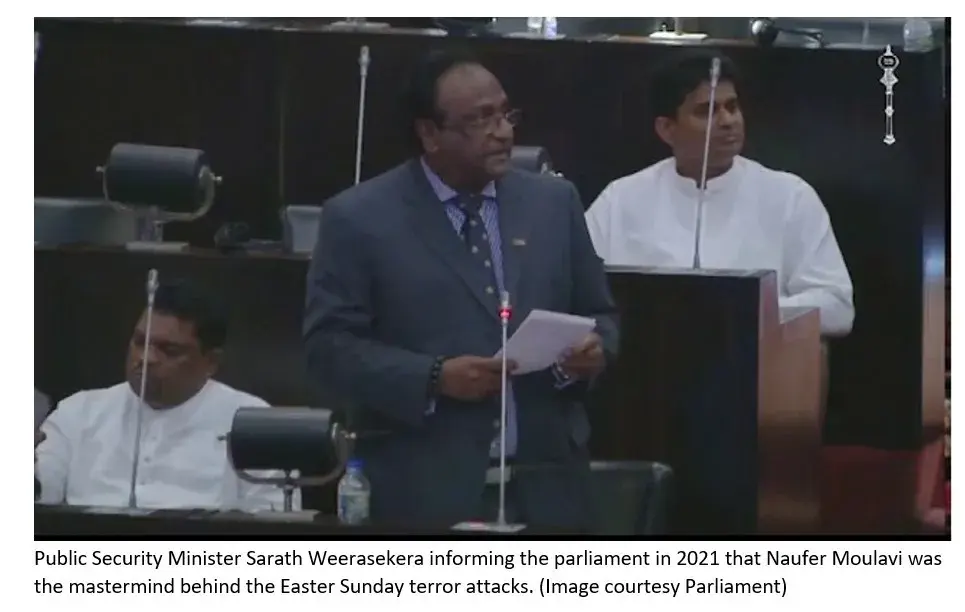
The search for the Easter Sunday terror masterminds took a dramatic turn in 2021, with the then Public Security Minister Sarath Weerasekera informing the parliament that the US Federal Bureau of Investigation (FBI) had identified radical cleric, Naufer Moulavi, as the mastermind behind the attacks. He said several foreigners had been involved in the Easter Sunday terrorist attacks and that an Australian national of Sri Lankan origin, Luqman Talib, had been arrested in Qatar. He said there was information that four Maldivian nationals were among the foreign suspects. He said it was also revealed that two Sri Lankan born Australian nationals Luqman Thalib and his son Lukman Thalib Ahmed had helped Zahran meet four Maldivian religious extremists.
The Archbishop of Colombo and others seeking justice for the victims of the Easter Sunday terrorist bombings refused to buy into Weerasekera’s claim based on an FBI report. The NPP has launched a fresh probe into the tragedy, and what one gathers from Public Security Minister Ananda Wijepala’s recent statement in the parliament is that the ongoing investigation is focussed on an allegation made by Azad Moulana, a former aide to TMVP leader and former State Minister Sivanesethurai Chandrakanthan alia Pilleyan, in a Channel Four programme that the military intelligence and Pillyean were involved in the terror attacks.
RELATED NEWS
View all
Politics by Vishvanath
Has 22A become the govt.'s Catch-22?
Aug 27, 2026
Politics by Vishvanath
22nd Amendment: A huge political gamble for govt.
Aug 21, 2026
Politics by Vishvanath
Move to raise retirement ages of judges: Options before govt.
Aug 05, 2026

Politics by Vishvanath
‘Cockroach’ uprising and echoes of Aragalaya
Jul 26, 2026