Current Affairs
Future of the Sri Lankan elephant hangs by a thin thread
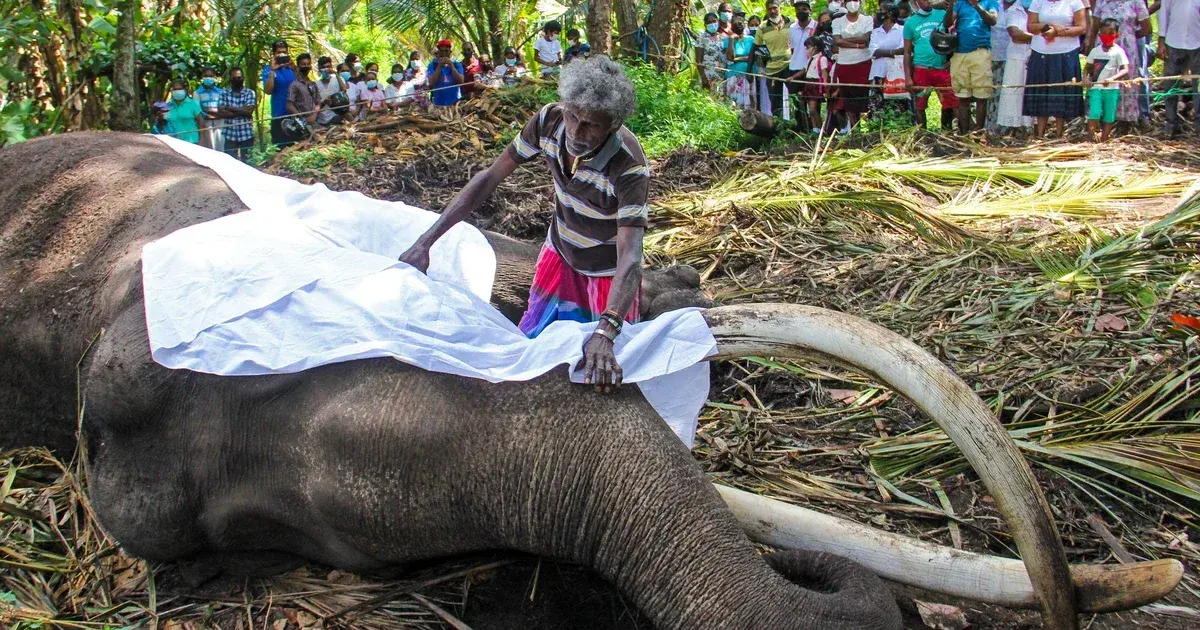
In 2025 elephant fatality was between 397 and 409 in Sri Lanka, high for a total population of about 6000-7000
By P. K. Balachandran
Colombo, December 30 – Not a day passes in Sri Lanka these days without its newspapers reporting the tragic death of an elephant somewhere in the island. There is apprehension among conservationists that the gentle giant of the jungle might vanish from the face of the earth before long.
This is a far cry from the situation in ancient times, when elephants were in abundance in Sri Lanka and were exported to India. Those days, capturing or killing a wild elephant was punishable by death. The King had the sole authority to capture or kill elephants. His stables were supervised by the ‘Gajanayaka Nilame’. Elephants were used for different purposes by the King - as draught animals; for ceremonial use, in warfare; and for entertainment. Kings staged elephant combats, used elephants to execute criminals and as decoys in the capture of wild elephants.
But as forests got encroached upon due to the rise in the human population and due to burgeoning economic activity, Human-Elephant Conflict (HEC) increased and resulted in a high casualty rate.
The elephant population has declined by more than 50% in the past three generations, with its habitat reduced to just 5% of its historical extent, experts say. Sri Lanka had lost more than 6,400 elephants in the past 24 years — an average of over 260 per year.
In 2025 elephant fatality in Sri Lanka was between 397 and 409, high for a total population of about 6000-7000.
In 2024, 388 elephants were killed in HEC. Of the elephant deaths, 84 were accounted for by shooting, 56 by electrocution, 52 by explosive baits like “Hakka Pattas” and the rest by poisoning and rail and road accidents, according to the Department of Wildlife Conservation (DWC).
For Jehan CanagaRetna, Vice President and Head of the Human-Elephant Conflict (HEC) Sub-Committee of the Wildlife and Nature Protection Society (WNPS), these statistics are a painful reminder of a crisis that has escalated to alarming levels.
“If elephant deaths continue to rise at the current rate, up to 70% of Sri Lanka's elephants would be gone,” added Dr. Prithiviraj Fernando Chairman, Trustee and Scientist (CCR, Sri Lanka) and Research Associate (Smithsonian Institution, USA).
Human Toll
The human toll in HEC has been high too. Between 2020 and 2024, over 2800 people had perished in HEC in Sri Lanka, which has been having a high rate of attrition in HEC among South and South Asian countries. In 2024, 155 people were in killed in HEC.
A Degrading Eco-system
But what is more worrying than the fatalities is the degrading of the eco-system which supports countless species. “The elephants’ movements create pathways for other animals. Their footprints form small water-filled ponds that host aquatic life,” said Ms. Nilanga Jayasinghe, the WWF Network’s Lead for Asian Elephants in an interview to the Anadolu News Agency.
Wild elephants are a “keystone species” Jayasinghe said. Keystone species are of great importance to many other species in an ecosystem, despite typically being relatively low in number. Like a keystone at the centre of an arch, the keystone species hold the other elements in the jungle in place. Without the keystone species, an ecosystem would be dramatically different or cease to exist altogether.
Conservationists across Asia, the home of the Asian elephant, are racing to protect the last 50,000 of the species. “50,000 is a low number. We need to do a lot more to ensure their survival,” Jayasinghe warned.
In fact, the Asia elephant is listed as endangered in the International Union for Conservation of Nature (IUCN) Red List of Threatened Species. This is only one step away from being critically endangered and two steps away from extinction.
Home Ranges
Asia is the most populated continent on the planet. So, there is stiff competition between humans and elephants for space and resources. Elephants need vast lands called “home ranges” to roam, forage and breed. Elephants walk on an average 48 kms in a day in search of food and water, so the need for space is acute.
But these “roam ranges” are being increasingly divided by roads, railways, plantations and human settlements. These are barriers restricting access to natural food and water. So, the pachyderms land up in inhabited places in search of food and water.
And while crossing roads and rail tracks, they get by passing trains or other vehicles. In Sri Lanka, about 5% of total fatalities are caused by road or rail accidents.
Various solutions — like reducing the speed of trains in identified collision hotspots, considered the most effective response — have been proposed over the years, but haven’t been successfully implemented.
Asian elephants are less targeted by poachers for ivory than their African counterparts. But there is brisk but illegal trade in elephant skin, meat and other body parts in Southeast Asia.
Straying elephants consume crops and destroy property. Anyone who comes in their way could be crushed to death. And fearing this, the affected people kill them without compunction
Mitigation Methods
Mitigation efforts have included extensive electric fencing with about 5800 kms having been electric fenced, community and seasonal agricultural fencing, installing early warning systems, conducting elephant drives and re-location.
Electric fencing is considered the most desired method of mitigation of course only when properly maintained and community supervised. The charge is just strong enough to stun the animal without causing serious injury. But farmers also illegally build fences with higher voltage that can kill elephants, a report in BBC said.
Farmers also use poison, explosive baits called "jaw bombs" and sometimes shoot at the animals.
Identifying Train Collision Hotspots
According to a story in “Mongabay” a study by the Department of Zoology and Environmental Sciences in the University of Colombo investigated elephant-train collision data from 2010 to 2023 and identified six collision hotspots. These were mainly along the northern and eastern railway tracks; on the eastern Trincomalee railway line, the stretch between the Gal Oya Junction and Trincomalee; on the eastern Batticaloa railway line, between Maho Junction and Batticaloa; and a segment of the northern (Jaffna) railway line, between Maho Junction-Anuradhapura, a stretch in northwest Sri Lanka.
The most critical collision hotspot was the Palugaswewa-Gal Oya Junction stretch, in the Hurulu and Gal Oya Eco Parks region, located between Palugaswewa and Gal Oya, according to Tanya Karunasena, lead author of the study and a teaching assistant at the University of Colombo.
Most hotspots were near railroads that passed through or close to protected areas, frequently used by elephants, Karunasena told Mongabay.
“We also observed that the majority of accidents occurred during the wet months from October to December and between 18:01 and 06:00,” she added. To limit casualties, controlling the speed of the train is crucial in these zones.
Managed Elephant Range
In 2009, conservation planners envisaged a Managed Elephant Range (MER) of about 23,000 hectares (57,000 acres) to reduce conflict. Bordering Udawalawe, Lunugamwehera and Bundala national parks, the MER was designed to allow elephants and people to coexist by keeping elephant corridors open rather than forcing animals into restricted spaces.
But it took more than a decade to gazette the MER, a task only completed by 2021, “Mongabay” pointed out.
Elephant Drives
The other method is to drive elephants into a designated safe zones. But conservationists strongly oppose these “elephant drives”. Environmental researcher Supun Lahiru Prakash argued that drives often worsen HEC by causing stress to the elephants, fragmenting their social groups and displacing them within unfamiliar territory.
Many return to their home range later. Prithviraj Fernando, chair of the Centre for Conservation and Research (CCR) told Mongabay that elephants have a strong ability to remember locations and tend to return to their home ranges even after being chased long distances.
“When driven from familiar areas, they become stressed and aggressive, increasing conflict along the way,” he pointed out.
Radio Collaring
Prithviraj Fernando’s pioneering work on radio collaring of elephants is hailed around the world as a landmark. But he laments that Sri Lanka continues to ignore scientific evidence, repeating past mistakes instead of adopting proven solutions.
In 2017, Sri Lanka unveiled a comprehensive National Action Plan on the HEC, designed by a committee led by Fernando. The plan recommended science-driven strategies, from landscape-level land use planning to village-centric electric fencing. Yet, the plan has seen little implementation, according to “Mongabay”.
Low-Cost Methods
There are low-cost methods of minimizing HEC. Elephants have a natural fear of African honeybees. Beehives on fences are effective. Farmers can also exploit beekeeping for earn extra income. Farmers can plot elephant repellent crops like orange and other citrus fruits.
Then there are battery operated AI devices that listen to elephant calls and respond with threatening sounds to gently deter herds. The Indian Railways use an AI based Intrusion Detection System. In 2025 alone this helped save 160 elephants in the Indian North-Eastern corridor.
There are also other low-cost methods such as putting up virtual barriers using lights, sounds or smells to create avoidance zones.
The Human-Elephant Conflict can be contained and even eliminated and loss of lives both animal and human can be prevented by adopting the existing scientific methods, sustained action and community cooperation. A beginning can be made with low-cost methods.
END
RELATED NEWS
View all

Current Affairs
Sri Lankan Presidential pardons- the good and the bad
Sep 11, 2026

Current Affairs
The pros and cons of joining BRICS- the dilemma of Pakistan and Bangladesh
Sep 09, 2026

Current Affairs
Disaster in Nepal gets embroiled in geopolitics.
Sep 08, 2026

Current Affairs
Why Mecca Pact, and what does it imply for its members, Israel and India?
Aug 18, 2026