Current Affairs
India-EU FTA will be both rewarding and challenging to India
Pakistan, Bangladesh and Sri Lanka will face Indian competition in apparels
By P.K.Balachandran
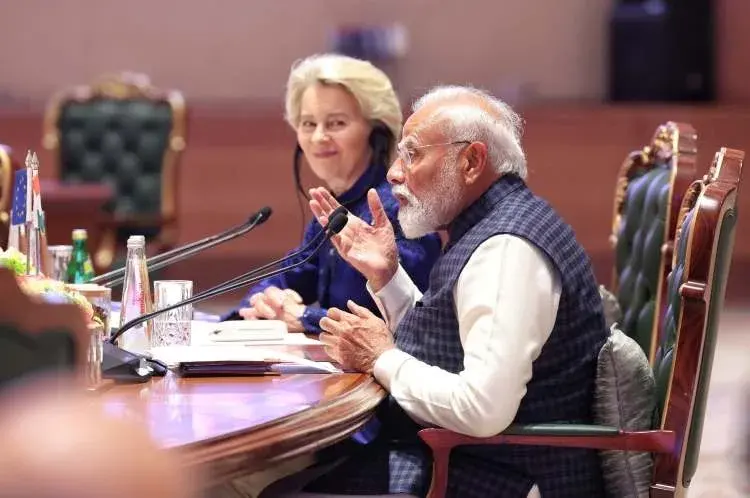
Colombo, January 31 – On Tuesday, the European Union (EU) and India sealed a landmark Free Trade Agreement (FTA), bringing two of the world’s largest economies closer together at a time when global trade is increasingly shaped by geopolitical tensions.
The pact, hailed grandly as the “Mother of All Pacts” slashed tariffs, opened up services and agriculture, and marked the largest trade agreement either side has ever signed. The FTA covers nearly two billion people and almost a quarter of global economic output, notes Euro News.
Where does it Leave the US?
The European Commission President Ursula von der Leyen said that the FTA will be a rules-based cooperation, apparently hinting at the non-rules based order foisted on the world by US President Donald Trump by weaponizing tariff.
The EU-India FTA allows EU to sell its farm products in India, a facility not given to the US. Entry into the agriculture sector issue is holding up the India-US trade deal. The India-EU FTA shows that India has tilted towards the EU, though the US is still India’s single largest trading partner.
Radical Tariff Reductions
Radical tariff reductions mark the India-EU FTA. India will eliminate or reduce duties on 96.6% of EU goods, while the EU will liberalise 99.5% of its tariff lines on imports from India. These will be done over the next seven years with the deal coming into force in 2027 after ratification and enacting the relevant protocols.
EU-India trade Now
In 2024, EU-India trade in goods was worth over €120 billion – with €71.4 billion in EU imports and €48.8 billion in EU exports. The EU imported services from India to the tune of Euro 37 billion and exports were worth Euro 28 billion.
Goods imported from India by EU, were electrical machinery and equipment, organic chemicals, machinery and mechanical appliances, including nuclear reactors and boilers, iron and steel, Pharmaceutical products, textiles, and apparel and clothing accessories.
Services Sector Opened
The FTA expands access to the EU for Indian IT services, digital firms, IT engineers and professionals. While the deal stops short of unfettered labour mobility, it improves recognition of qualifications, short-term entry for professionals and gives market access in areas such as financial services, maritime transport, and digital trade.
For the Indian economy in which services account for over half of GDP and a rising share of exports, this is a big opening into EU, says www.policycircle.org
India’s services commitments under this FTA are the most ambitious it has ever undertaken, surpassing the concessions granted to partners such as the United Kingdom and Australia. EU companies will gain more predictable access to key sectors including financial services, maritime transport, and professional services, with clearer rules on licensing, local presence, senior management, and board requirements.
Total EU services exports to India reached €29bn in 2024, a figure expected to grow substantially under the new legal and market access conditions introduced by the FTA.
In 2024, EU exports to India included machinery and electrical equipment as the largest export category. These products currently face tariffs of up to 44%, which will be mostly eliminated over a period of five to ten years. In respect of aircraft and spacecraft and pharmaceuticals also, duties will be slashed.
India’s average industrial tariffs exceed 16%, among the highest of any major economy. Their reduction is therefore particularly significant for Europe’s capital-intensive industries, which have long faced steep barriers to the Indian market.
One of the most striking changes concerns motor vehicles. Indian tariffs will fall from 110% to as low as 10%, albeit subject to quotas. Car parts will eventually become tariff-free. For European manufacturers, this opens access to India, the world’s fastest-growing large automotive market.
Breakthrough for Agri-food Products
Agriculture has long been the most sensitive area in EU–India negotiations. Currently, Indian tariffs on agri-food products average 36% and can reach 150%, effectively shutting out many European exports.
In 2024, EU agri-food exports to India were worth just €1.3bn, due in large part to prohibitive tariffs. With the FTA, Europe’s high-value agri-food exports — from olive oil and wine to confectionery — are set to gain meaningful access to India’s rapidly expanding middle-class consumer market.
Wine exports, which currently face tariffs of 150%, will see duties cut sharply to between 20% and 30%. Spirits, subject to tariffs of up to 150%, will benefit from a substantial reduction to a flat 40%, while beer tariffs will fall from 110% to 50% under the agreement, according to www.policycircle.org
Olive oil will see one of the most dramatic changes, with tariffs of up to 45% fully eliminated, opening the door for wider consumption beyond premium niches.
EU trade with India already supports around 800,000 jobs across the EU and the FTA is expected to reinforce employment in manufacturing, services, and supply chains.
India’s consumer base of 1.4 billion and its vast pool of human capital are major attractions for the EU. For European exporters, the FTA will lead to savings up to €4 billion per year in customs duties — money that can be reinvested into production, wages, or lower consumer prices.
FTA Leads to Value Chains
Rather than treating FTAs as export-promotion tools alone, India is now going to use FTAs to reposition itself within global value chains. Lower tariffs on European machinery, components, and capital goods will reduce the cost of producing in India for export.
This is particularly relevant for fields like electronics, pharmaceuticals, chemicals, and automotive components.
Dedicated to Helping SMEs
A dedicated SME chapter aims to ensure that smaller firms can translate the agreement into real commercial opportunities. Both sides will set up SME contact points and a shared digital platform providing clear, up-to-date information on tariffs, customs procedures, and market-entry requirements.
Good Outcomes Not Automatic
However, the good outcomes will not be automatic. Indian firms will face stringent European requirements on quality, traceability, environmental compliance, and labour standards.
The EU has insisted on strong commitments on labour rights, climate obligations, and sustainability. India has accepted these, including alignment with the Paris Agreement and cooperation on environmental standards.
Compliance costs can be high, especially for small exporters. But the alternative, remaining outside high-standards markets, is costlier in the long run. As carbon border measures and due-diligence laws come into play, access to Europe will increase. The FTA will accelerate a process, India cannot indefinitely postpone, Policy Circle.org says.
Strong Regulations Needed
The EU has insisted on strong commitments on labour rights, climate obligations, and sustainability. India has accepted these, including alignment with the Paris Agreement and cooperation on environmental standards.
The risk of regulatory overreach is real. Compliance costs can be high, especially for small exporters. But the alternative, remaining outside high-standards markets, is costlier in the long run. As carbon border measures, due-diligence laws, and ESG norms spread, access to Europe will increasingly depend on regulatory convergence.
Investment protection, dispute settlement mechanisms will have to be agreed upon. Legal vetting will take months, ratification longer, with full operation expected around 2027. Political durability will be tested in parliaments, courts, and customs offices.
India will have to align skills, apprenticeships, testing infrastructure, and regulatory capacity with European benchmarks. State governments, customs authorities, and regulators should cooperate. Small firms should be able to navigate compliance requirements.
Concerns in South Asia
The EU-India FTA has sent tremors across South Asia. Pakistan currently enjoys duty-free access to the EU under the GSP+ scheme. But this in contingent on strict compliance with 27 international conventions covering human rights, labour standards, environment, and governance, which significantly increase costs for exporters. In contrast, India would not face comparable ongoing compliance obligations under the FTA.
Pakistani industrialists have sought concessions and aid from their government to overcome existing difficulties.
The EU’s textile market is dominated by China with a 28-30 percent share, followed by Bangladesh, which controls 21-22 percent, largely due to its duty-free access. India, in comparison, has only 5-6 percent of the market, exporting about $8 billion worth of textiles annually. Taxes on Indian exports, ranging from 9-12 percent, have historically limited competitiveness. The FTA will now remove the tariff impediment.
Unlike India, Pakistan, Bangladesh and Sri Lanka will have to comply with strict human rights standards to keep its GSP Plus concessions. However, this week, Sri Lanka re-affirmed its commitment to abolish the controversial Prevention of Terrorism Act (PTA).
And unlike India, Bangladesh and Sri Lanka have to import textiles to make garments, which will affect their competitiveness.
END
RELATED NEWS
View all

Current Affairs
Sri Lankan Presidential pardons- the good and the bad
Sep 11, 2026
Current Affairs
The pros and cons of joining BRICS- the dilemma of Pakistan and Bangladesh
Sep 09, 2026
Current Affairs
Disaster in Nepal gets embroiled in geopolitics.
Sep 08, 2026
Current Affairs
Why Mecca Pact, and what does it imply for its members, Israel and India?
Aug 18, 2026