Current Affairs
India’s bid to break out of isolation through the Indian Ocean Conference
New Delhi had lost its place in the Global South after missteps during the Iran-US war
By P.K.Balachandran
Colombo, April 10 – India has high stakes in the 9th Indian Ocean Conference (IOC) being held in Port Louis, Mauritius from April 10 to 12. Political observers say that through the multi-national conference, New Delhi hopes to retrieve the ground it lost in the Global South due to its missteps in responding to the Iran-US war.
While the rest of the Global South stood by Iran, denouncing the US and Israel as the aggressors, India was silent, indicating a covert alliance with US and Israel. And much to India’s chagrin, arch “enemy” Pakistan and “rival” China, were credited for bringing about a ceasefire.
By alienating itself from the Global South, India lost its legitimacy as the current President of BRICS, an organisation of the Global South in which Iran is a member.
The Indian Ocean Conference (IOC) is a Global South organisation in existence since 2016. It is a brainchild of India, its own bloc in the Indian Ocean Region, a bloc in which membership is restricted to India’s allies and friends.
Pakistan, China and Myanmar are not invited, though Pakistan and Mynamar are in the Indian Ocean area. But Australia and the UK are, though the former is in the Pacific Ocean and UK in the Atlantic.
Maldives has not been invited because of its quarrel with Mauritius over the Chagos islands which house the US Diego Garcia airbase. Maldives’ relations with India is not very warm because of its tilt towards China.
That the IOC is an Indian club become further clear when a country like Bhutan, which is completely landlocked and is in the Himalayan north, is a member, just because it is under Indian influence.
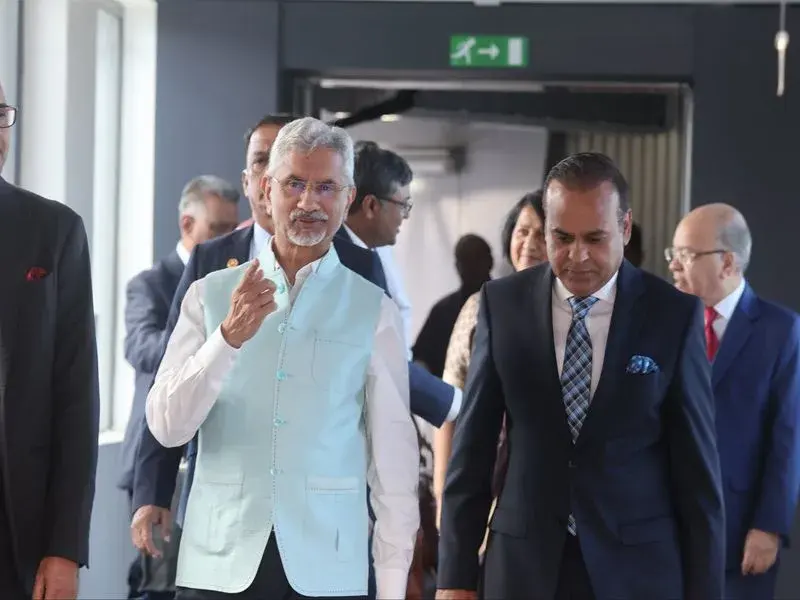
At the Mauritius meet, Bangladesh is expected to be given a significant role as India is trying to make up with that country after a hiatus of more than a year due to the ouster of its ally, Sheikh Hasina, in August 2024. The Indian Foreign Minister Jaishankar and his Bangladeshi counterpart, Dr.Khalilur Rahman, went by the same flight from New Delhi to Port Louis. During the seven- hour flight, Jaishankar would have tried to restore the relationship suggesting deals.
Discussions in the 9th IOC are expected to be on "Collective Stewardship for Indian Ocean Governance".
The theme of the 8th. IOC held in Oman in February 2025 was “Voyages to New Horizons of Maritime Partnership.” Speaking at the conference, Jaishankar said, “In a volatile and uncertain era, we seek stability and security as the baseline. But beyond that, there are ambitions and aspirations that we strive to achieve. They will be easier reached when we look out for each other, supplement our strengths and coordinate our policies."
“Currently there is considerable churn in world affairs. At the two ends of the ocean, this churn is at its sharpest today. In the Middle East/West Asia, there is a serious conflict underway with the potential for further escalation and complication."
"At the same time, longstanding issues are being revisited, sometimes with a radically different approach. Its maritime consequence is visible in a serious disruption of global shipping, with considerable cost to our economies. At the other end, the Indo-Pacific has been witnessing deeper tensions and sharper contestations.”
“Like other parts of the Global South, the Indian Ocean nations too face resource constraints and economic headwinds. Many of them are struggling to meet their Sustainable Development Goals. In quite a few cases, debt is a serious concern. Some of that arises from stresses of the international economy, but in certain cases, from imprudent borrowing and unviable projects.”
That was an oblique reference to China’s Belt and Road projects which India has been describing as “debt traps”. Referring to rebuilding connectivity in the region, Jaishankar called for a truly shared endeavour, which will be marked by consultation, and transparency rather than unilateralism and opacity.
"Yet another widespread concern is the challenge faced by the Indian Ocean states to monitor their Exclusive Economic Zones and secure their fishing interests. Nor can they be impervious to illegal trafficking of various kinds and the spectre of terrorism. Each of these dimensions – and certainly their cumulative impact – has a strong maritime implication," Jaishankar said.
He claimed that India was contributing to these shared endeavours by “rapidly strengthening its own capabilities, forging partnerships with Indian Ocean neighbours, shouldering responsibilities, stepping up in times of trouble and providing leadership where required.”
Jaishankar’s declamation is expected to be India’s line during the 9th.Conference in Mauritius also. Going through the proceedings of the previous IOC conferences, it is apparent that each country will highlight its own maritime security concerns.
Nevertheless, common ground has to be found by the end of the deliberations. The norm in organizations led by India is to find a consensus. No contentious issues can be raised. This adversely affects the quality of the conferences. Many issues like safeguarding maritime zones and national sovereignties are raised but concrete decisions and programmes of action do not follow.
Therefore, these conferences turn out to be opportunities for networking and to get a feel of the thinking in various countries. They are not events of practical value.
Claims are made by India that it is the “net security provider” in the Indian Ocean region, but when push comes to shove, in cases where a bigger power is involved, India is found wanting. When the US navy torpedoed the unarmed Iranian naval vessel IRIS Dena in India’s backyard, India failed to prevent it, even condemn it because the perpetrator was the powerful US.
At best, the IOC is just a means to signal to the world, the Big powers as well as the Global South, that India is not a write -off and that it can organize such an inter-continental gathering to let the world know its views on key issues of the day.
India is also trying to revive BIMSTEC ( Bay of Bengal Initiative for Multi-Sectoral Technical and Economic Cooperation) as an alternative to SAAC (South Asian Association for Cooperation) because “enemy” Pakistan, and “rival” China, are not members of BIMSTEC. SAARC has Pakistan, and therefore, the need to keep away.
The Pakistan and China factors have prevented India from playing a role in BRICS too. While China is pushing for Pakistan’s admission to BRICS, India is resisting it saying that Pakistan is a terror exporter. But now, to India’s dismay, the “terror exporter” is hailed as a peace maker in West Asia following the US-Iran war.
Russia wants India to activate the Russia-India-China (RIC) forum for cooperation for the larger good of Eurasia, but India is reluctant to do it because of the fear of Chinese dominance.
India feels most comfortable in company chosen by it. The IOC is perhaps the only international group in which its dominance is acknowledged. Hence its importance to New Delhi.
END
RELATED NEWS
View all

Current Affairs
Sri Lankan Presidential pardons- the good and the bad
Sep 11, 2026
Current Affairs
The pros and cons of joining BRICS- the dilemma of Pakistan and Bangladesh
Sep 09, 2026
Current Affairs
Disaster in Nepal gets embroiled in geopolitics.
Sep 08, 2026
Current Affairs
Why Mecca Pact, and what does it imply for its members, Israel and India?
Aug 18, 2026