Current Affairs
Is QUAD heading towards irrelevance if not dissolution?
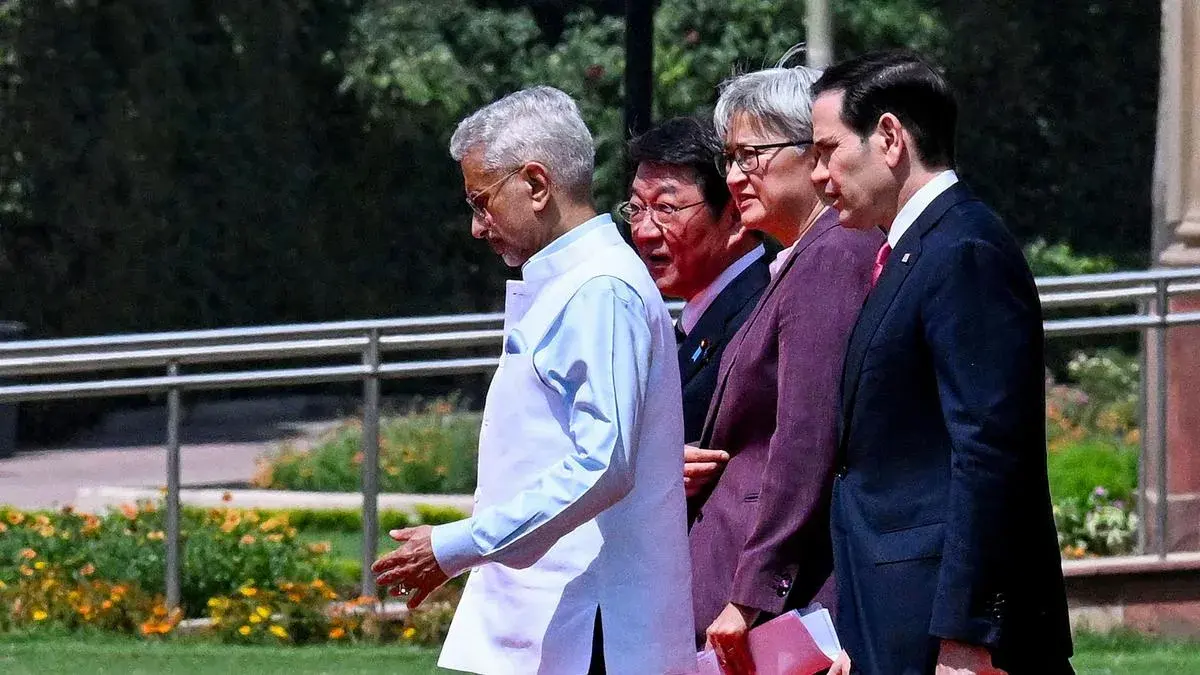
QUAD Foreign Ministers disperse without finalising a date for the summit
By P.K.Balachandran
Colombo, May 27 - The QUAD Foreign Ministers’ meeting, which took place in New Delhi on Tuesday, ended without deciding on a date for the Heads of Government summit. The summit was expected to be held in September in New Delhi, but now, that is in doubt.
The recurring inability of the heads of government to meet has cast a shadow on the relevance of the four-nation grouping, which comprises the US, Japan, India and Australia.
Meant to contain expansionist China, the QUAD now finds the US seeking economic accommodation and greater trade with China. India is seeking investments from China, and Australia wants to maintain and grow its trade with China. The only member of the grouping which really needs QUAD is Japan, as it has been at odds with China historically. It was Japan that was instrumental in establishing the QUAD in 2007.
The future of QUAD is also being questioned because many similar multinational organizations are under stress, with member countries unable to agree on a common and meaningful agenda due to clashing interests. NATO, BRICS, SAARC and OPEC are all either under strain or are facing irrelevance.
“The Hindu” reported on Wednesday that there was speculation that the QUAD night revert to being a Ministerial dialogue, as it was before it was upgraded to the Heads of Government level in 2021. It was even said that the summit could be held on the sidelines of other multilateral meetings where all four leaders may be present later this year, such as the UN General Assembly or G-20 Summit in the US in December.
Effect of Trump’s China Visit
After his meeting with Chinese Prime Minister Xi Jinping, US President Donald Trump claimed that Xi had agreed to buy billions of dollars of US agricultural products and 200 Boeing aircraft. The White House said that China would purchase at least US$ 17 billion worth of US agricultural products per year.
The Chinese have moved to re-register banned US meat firms, which means that these companies can export to China. The Chinese have also agreed to review a bunch of US biotechnology traits that have to be approved scientifically. This is all on top of the 25 million metric tonnes of soybeans China agreed to buy in October 2025.
However, Beijing’s readout did not directly confirm those deals, only saying that both sides would “promote expanded two-way trade” in agricultural goods and that they had made arrangements about China procuring American planes.
Trump did not make Taiwan an issue in his talks with Xi, though Xi made clear China’s known position on the island. Trump’s attention was entirely on saving the American economy and seeing that Iran was brought in line without resuming hostilities.
It was in this geo-economic context that the visit to New Delhi by the US Secretary of State Marco Rubio and the QUAD’s Foreign Ministers’ meeting in New Delhi on Monday should be seen. On QUAD, Rubio said, India plays an important role in the US’s Indo-Pacific policy and hopes to “renew” the QUAD engagement.
But Rubio’s main agenda in New Delhi was to make India buy US and Venezuelan oil in lieu of Russian oil, Boeing planes and other US industrial and agricultural products. Re-activating QUAD was clearly a secondary concern.
Rubio’s primary task appears to be to soothe ruffled feelings in India about the way Trump had been treating its “strategic partner” both verbally and in matters of trade.
Indicating the close relations between Trump and Modi, Rubio said that the two leaders are expected to meet in June at Evian in France for the G-7 summit. Modi is also expected to travel to the US for the G-20 summit at Mar-a-Lago in December this year.
The US State Department spokesperson Tommy Pigott added that Rubio had extended an invitation, on behalf of President Trump, to Prime Minister Modi to visit the White House.
The US Ambassador to India, Sergio Gor, also stressed US-India economic ties rather than Indo-Pacific security through QUAD, “When I saw Indian companies committing US$ 20.5 billion to the US economy, I was simply blown away,” he told the Indian media.
Though India and the US have signed important defence agreements even recently, the gulf between them has not been bridged.
Richard Fontaine and Lisa Curtis noted in a piece in “Foreign Affairs” in January this year that India had signed a one-year agreement to increase imports of liquefied petroleum gas from the United States. The two governments had completed a deal for India to purchase US$ 93 million worth of Javelin anti-tank missile systems and precision-guided artillery and signed a nearly US$ 1 billion contract for the maintenance of the Indian Navy’s US -made MH-60R Sea Hawk helicopters. The annual Malabar naval exercise involving Australia, India, Japan, and the United States took place off the coast of Guam in mid-November 2025.
“But these are small steps. If Washington wants to really repair the relationship, it will have to go big. It can begin by finally concluding a trade deal that lowers the massive US tariffs, even if it means accepting some protectionism in India’s agriculture sector, which still employs almost 50% of the country’s population,” Fontaine and Curtis said.
The two experts advised Trump not to bracket India with Pakistan.
“The White House also needs to more clearly understand the roles that New Delhi and Islamabad play in the Indo-Pacific, particularly in the context of strategic competition with Beijing. An India that is more capable of defending its border with China and is more active in the surrounding ocean can stretch Chinese resources and complicate Beijing’s planning.”
“US-Indian technology cooperation can assist the United States in outcompeting China, particularly in artificial intelligence, as American tech giants are pouring billions into the Indian market. And the United States and India can strengthen their diplomatic positions by taking them together, particularly within the QUAD framework. If Washington wants to really repair the relationship, it will have to go big,” the authors said.
It is important for the US to have India in QUAD, James Brown, a professor of international relations at the Tokyo campus of Temple University, told DW.
"The US, Japan and Australia already had an important and effective trilateral security arrangement, but the whole purpose of the QUAD was to bring India in as another power to give it more influence and reach," Brown said.
“Unfortunately, this US administration does not seem to have grasped that or valued India's presence as an ally, which has badly alienated Modi," he added.
But QUAD cannot be expected to function like a political or military alliance. QUAD is not a treaty alliance with binding commitments on member states. Equally, it was not designed to operate with the rigid discipline of NATO-style institutions. The structure is informal and flexible, providing a different type of resilience.
It is submitted that the QUAD has weathered previous periods of inactivity and political hesitation. Australia, under former Prime Minister Kevin Rudd, distanced itself from the alliance out of concern that it would hurt Australian business interests in China.
Given the nature of QUAD, its future will depend less on perfect unity among members and more on their capacity to maintain cooperation despite disagreements.
END
RELATED NEWS
View all

Current Affairs
Sri Lankan Presidential pardons- the good and the bad
Sep 11, 2026
Current Affairs
The pros and cons of joining BRICS- the dilemma of Pakistan and Bangladesh
Sep 09, 2026
Current Affairs
Disaster in Nepal gets embroiled in geopolitics.
Sep 08, 2026
Current Affairs
Why Mecca Pact, and what does it imply for its members, Israel and India?
Aug 18, 2026