Current Affairs
Nobel Laureate Maria Machado will be the US point person in Venezuela
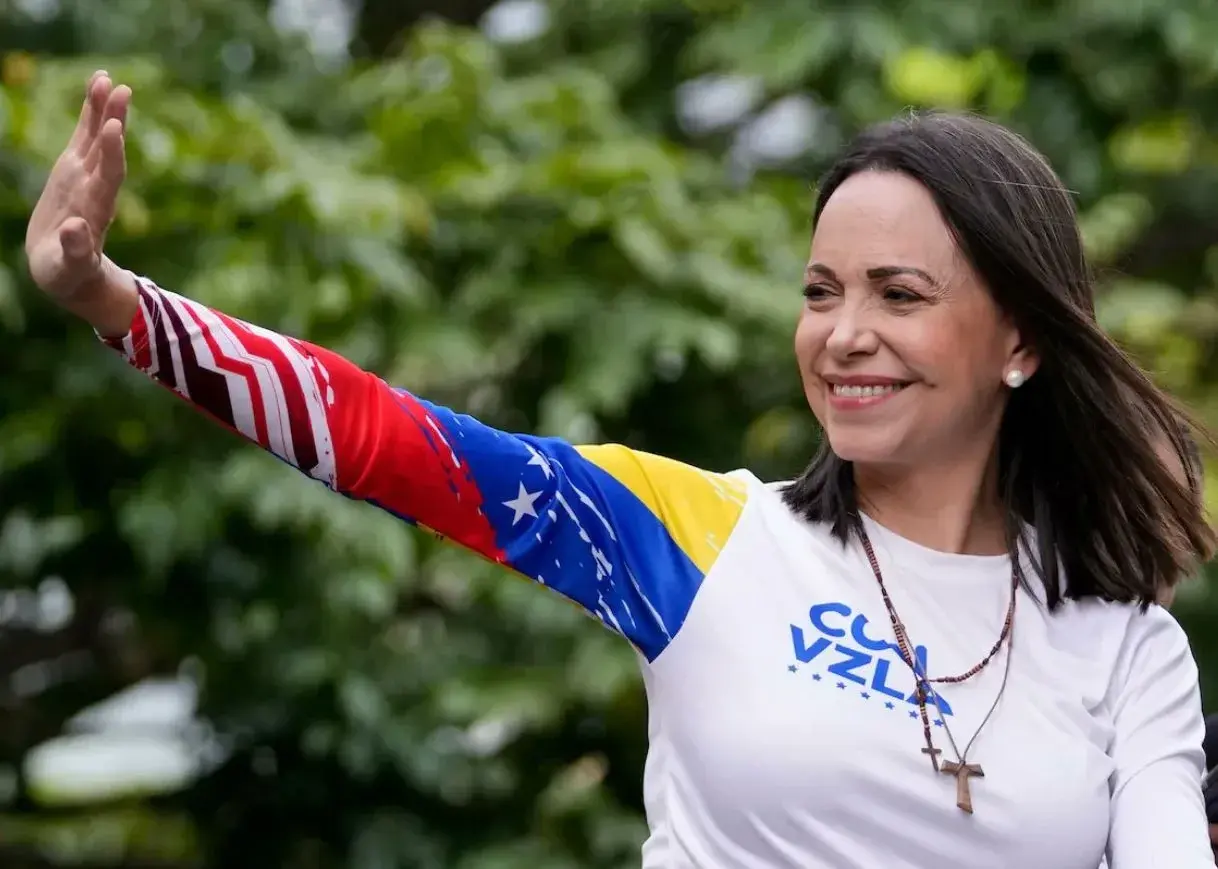
The Nobel Peace Prize winner, current in self-exile, hopes to spearhead a right wing, pro-US movement in Castroist Venezuela
By P.K.Balachandran
Colombo, October 13 -Maria Corina Machado (58), who was awarded the Nobel Peace Prize this year for being a crusader for democracy in Venezuela, will be the US point person in that country, if and when she returns to it from exile.
Venezuela has been under left wing, anti-US, pro-China and authoritarian Presidents like Hugo Chavez and Nicolas Maduro for decades and is crying out for change.
Machado won the coveted prize for her indefatigable fight for democracy and the rule of law in Venezuela. This South American country, like many others in the Global South, has had elected leaders who turned out to be dictators, including the current President Nicolas Maduro.
Venezuela’s elected Presidents have routinely used or misused the institutions of democracy to run their dictatorships. And they had to be overthrown by mass movements. Machado herself had made a name for herself at home and abroad by battling Maduro.
Venezuelan leaders from Hugo Chavez onwards were populist poplar men. They won their elections on leftist platforms and also set in motion policies for the benefit of the common man on the pattern of Fidel Castro of Cuba. But at the same time, they were power hungry, intolerant of dissent and brazenly misused State institutions.
They ruined Venezuela, which went from being the wealthiest country in Latin America to be the most miserable in the Western hemisphere. Venezuela is experiencing the largest mass migration in the world. Roughly 8 million Venezuelans have fled the country in search of a better life and opportunities abroad. Hugo Chavez’s “21st-century socialism” has pushed 94.5% of the population into poverty.
For all this, Venezuela has the largest proven oil reserves on earth, a strategic location in the Caribbean, and highly skilled human capital. And yet it has ended up in ruins—with a GDP reduced to less than a third of what it was in the 1990s. Its public services are in a shambles. Over half a million businesses have shut down.
Enter Machado
But a new leadership has emerged that promises to end socialism and statism and to open the country to economic freedom. That leader is Nobel Laureate Maria Corina Machado. The 58 year old qualified engineer promises to reverse the policies of Centre-Left Chavez and Maduro.
Machado coined the term “popular capitalism” in 2011. Though from a wealthy family, Maduro traversed the length and breadth of Venezuela solo, driving her car herself, explaining her concept to common people.
Machado’s economic proposal is in the plan named “Venezuela, Land of Grace.” It aims to transform Venezuela into the most important energy hub of the Western Hemisphere and the most reliable trade partner of the US.
She plans to (1) re-establish legal security and the protection of private property (2) Open the country to private investment and reintegrate it with the global economy.
Machado believes that these goals will triple the size of Venezuela’s economy in fifteen years. She believes that under a stable liberal democracy, Venezuela’s GDP could grow from today’s US $120 billion to more than US$ 400 billion by 2040.
Machado’s program identifies twelve key productive sectors, with a private market opportunity of US$ 1.7 trillion over the next fifteen years. These sectors are - oil, gas, metals and minerals, transportation, financial services, technology and professional services, tourism, real estate, agriculture, healthcare and education.
Natural Resources
Venezuela holds more than 303 billion barrels of proven oil reserves, about 18% of the global total, making it the largest in the world. With nearly 195 trillion cubic feet of natural gas, it ranks as the eighth-largest reserve worldwide and the largest in South America. The Guayana Shield also contains world-class iron and gold deposits, along with coltan and bauxite.
But over the years, all these resources were wasted, looted, and trafficked in the black market by the leftist elite.
Machado has been clear that she intends to make Venezuela the main US ally in Latin America, stressing that Venezuela’s recovery cannot be achieved with Russia, Iran, and China as partners as at present.
Moises Rendon and Sarah Baumunk of the Centre for Strategic and International Studies wrote in April 2018, that the leftists’ link with China was disastrous. China took advantage of a collapsed and cash-strapped Venezuela to sign one-sided financial agreements. Inspired by state-dominated economic systems, both Chavez and Maduro welcomed China’s financial support to fuel their “socialism of the 21st Century.”
There are four main issues that should concern Venezuelans regarding China’s role in Maduro-ruled Venezuela, the authors say: These are - (1) China is propping up Maduro’s undemocratic and repressive narco-regime; (2) China’s investments fail to bring long-term benefits (3) Chinese loans and agreements are not transparent and are, in some cases, illegitimate; and (4) China’s agreements create long term energy and security concerns.
Even as other countries have backed off from doing business with Venezuela, China has doubled down on its support. Till 2018 Venezuela had received over US$62 billion from China, which was 53% of all money lent by China to Latin America. In 2018 China owned US$ 23 billion worth of Venezuela’s foreign debt, making it the country’s biggest creditor. China was the sole provider of cash to help the Maduro government honour its debts. However, lately, in the face of Venezuela’s debt, China has seemed reluctant to increase its exposure to Venezuela.
Nevertheless, given Venezuela’s limited funds (due to US sanctions and massive foreign debts), the Maduro regime will need to seek even more funding from the Chinese in the future, the authors said. While engagement with China could be seen by Latin American countries as an attractive path to development, the short-term benefits often lead to long-term dependency, the authors warn.
And Chinese investments focus on extracting natural resources and trading high value-added manufactures from China for Latin American commodities. This is the colonial trading model that the Global South is trying to shed. Commodity-driven relationships quickly boost the economy in resource-rich countries like Venezuela, but they do not help the building of institutional capacity.
While China may prop up these economies now, a change in its commodity demands or the discovery of cheaper goods elsewhere, could leave these economies devastated. Such a relationship disproportionately affects Venezuela, a country completely dependent on its natural resources, the authors warn.
Chinese investments lack even the most basic norms of transparency. China has refused to join the Paris Club, which sets standards for bilateral investments, they point out. Without the accountability of a forum like the Paris Club, the international community has limited ability to find out the extent of China’s investment in Venezuela.
This lack of transparency adds yet another layer to the entrenched corruption of the Maduro regime. As of 2017, Venezuela was rated the 11th most corrupt country in the world, the authors point out.
Machado’s Ties with US
Machado has been a strong supporter of President Trump’s military buildup in the Caribbean, arguing, like Trump, that Maduro poses an enormous security threat to the region.
“This is about saving lives,” Machado told Fox News after the US began bombing suspected drug boats in the Caribbean in September. “Not only Venezuelan lives, but also lives of American people, because as you have said, and we have heard, Maduro is the head of a narco-terrorist structure of cooperation.”
In a series of interviews with The New York Times late in 2024, Machado said that for Trump, Venezuela offered “an enormous foreign policy victory in the very, very short term.”
Machado has vocally supported Israel’s actions in Gaza, praised Benjamin Netanyahu as a democrat and supported Israel’s decision to shift the capital from Tel Aviv to Jerusalem.
Trump and Machado Patch Up
US President Donald Trum was very disappointed that Machado beat him in the race for the Nobel Peace Prize. “The Nobel Committee proved they place politics over peace,” White House communications director Steven Cheung said in a post on social media. But Machado held out a hand of friendship to Trump. But she spoke to the US President and Trump confirmed that he spoke with Machado.
“The person who actually got the Nobel Prize called today, called me and said, ‘I’m accepting this in honour of you, because you really deserved it. A very nice thing to do. I didn’t say, Then give it to me, though I think she might have, Trump joked.
“I’ve been helping her along the way,” Trump added. “They need a lot of help in Venezuela, it’s a basic disaster.”
END
RELATED NEWS
View all

Current Affairs
Sri Lankan Presidential pardons- the good and the bad
Sep 11, 2026
Current Affairs
The pros and cons of joining BRICS- the dilemma of Pakistan and Bangladesh
Sep 09, 2026
Current Affairs
Disaster in Nepal gets embroiled in geopolitics.
Sep 08, 2026
Current Affairs
Why Mecca Pact, and what does it imply for its members, Israel and India?
Aug 18, 2026