Current Affairs
Pakistan failed to repeat an initial success in the May 2025 war against India, says a Swiss study
By P.K.Balachandran
Colombo, January 28 - The May 7 to 10, 2025 clash between the Pakistan and Indian air forces initially saw the Pakistan Air Force (PAF) achieve a clear tactical victory by shooting down several enemy fighters. But the PAF failed to deliver in subsequent strikes against Indian installations because of the efficient Indian air defence system.
When the Indians retaliated in strength, the Pakistani air defence was found to be wanting, said a study by the Centre for Military History and Perspective Studies (CHPM) in Switzerland.
The study, entitled “Operation Sindoor: The India-Pakistan Air War (7-10 May 2025),” conducted by Adrien Fontanellaz, stated that the effectiveness of the Indian air defence system was “one of the surprises of the conflict.”
Fontanellaz further said that the Indian Air Force (IAF) also managed to significantly degrade the enemy's air defence system, carrying out a series of spectacular strikes against Pakistan’s principal Air Force stations. “Thus, by achieving clear air superiority, India coerced Islamabad into requesting a ceasefire,” the study said.
Following are the highlights of the report-
India’s Operation Sindoor
After the attack on Pahagam by Pakistan-based terrorists n April 22, India’s three armed services, in coordination with the various intelligence agencies, developed several response scenarios targeting the infrastructure of Pakistan-based jihadist organisations involved in attacks against India. Tactical planning began on 29 April, with the selection of targets – nine camps belonging to Jaish-e-Mohammad (JeM) and Lashkar-e-Toiba (LeT)– and the strike date was fixed for May 5. Seven of the nine selected camps were located close to the borde, and their destruction was assigned to the Indian Army. The remaining two were located deeper inside Pakistani territory, and the IAF was therefore tasked with striking them.
The operation was to be limited to specific targets, but India was prepared for a full-scale conventional war if Pakistan initiated it.
At around 01:00 hrs on May 7, Indian aircraft launched a series of long-range munitions against the complex that housed the JeM headquarters at Bahawalpur, 100 kms from the border. Five buildings were targeted and at least one was destroyed. Another formation released a second salvo of guided munitions against the LeT headquarters at Muridke. At least two of the targeted buildings were confirmed to have been hit.
One of the two Indian strike formations, composed of Rafale or Mirage 2000I aircraft, penetrated Pakistani airspace at very low altitude before executing a pop-up manoeuvre to release precision-guided bombs. In doing so, the aircraft deliberately exposed themselves to interception by Pakistani fighters and ground-based air defence systems.
But Pakistan had detected the IAF strike and diversion formations shortly after midnight. In twenty minutes, they identified eight distinct groups of six to eight aircraft each, concentrated along four main axes, totalling 60 aircraft, including 14 Rafales, reinforced by a further dozen combat aircraft.
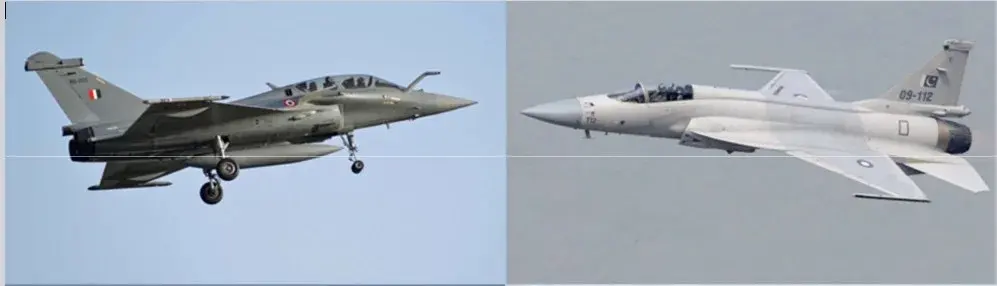
Several J-10C and JF-17 fighters fired at least one salvo of PL-15 long-range air-to-air missiles, while an HQ-9 or HQ-16 surface-to-air missile battery also engaged Indian fighters. Pakistani forces concentrated their fire on the Rafale. Islamabad subsequently claimed the destruction of six Indian aircraft over an hour-long sequence, including three Rafale, one Su-30MKI, one MiG-29UPG and a large drone, all shot down inside Indian airspace at ranges reported between 13 and 98 kilometres from the border or the Line of Control.
The Indian Air Force remained silent regarding its losses during the night as well as the return fire from its combat aircraft, merely stating that all pilots involved in the operation were safe.
The subsequent circulation of images of wreckage fragments on social media and in Indian and Pakistani media, however, confirmed the loss of at least one Rafale (serial number BS001), one Mirage 2000 and either one MiG-29UPG or one Su-30MKI.
The discovery of multiple PL-15 missile casings on Indian territory indicates that other IAF pilots successfully decoyed or evaded some of the missiles fired against them. The presence of an intact BrahMos on the ground further suggests that at least one pilot had to jettison his underwing stores to improve the effectiveness of evasive manoeuvres, demonstrating that, in addition to several aircraft losses, the Pakistanis achieved a mission kill, that is, forcing an adversary to abandon its mission before it could be carried out.
The Indians appear to have assumed that the Pakistanis would continue adhering to their established practice of refraining from firing at aircraft outside Pakistani airspace. Indian pilots were therefore likely taken by surprise by long-range Pakistani fire. Some Pakistani fighters may have succeeded in remaining covert by switching off their electromagnetic emissions and by flying at low altitude in order to conceal behind the mountainous terrain. And, as in 2019, the Pakistanis did their best to disrupt Indian communications.
PL-15 Threat Underestimated
Indian intelligence reportedly underestimated the threat posed by the PL-15 missile, assuming that the PAF possessed an export variant with a maximum range of 150 kilometres, well short of the 200 kilometres at which some missiles were actually fired, surprising Indian pilots.
This misjudgement may have resulted from deliberate deception, as shortly before the operation, documents from the Chinese firm CATIC, allegedly leaked, suggested the delivery to Pakistan of a significantly downgraded export variant of the PL-15.
Additionally, the PAF is believed to have used its Link 17 data link, capable of integrating Western and Chinese technologies, to conduct cooperative engagements. If this were the case, JF-17 and J-10C fighters may have had the option to keep their radars off and to fire PL-15 missiles with active radar guidance using targeting data transmitted by the Erieye, which was orbiting well to the rear of the formation. The Erieye radar system is an Airborne Early Warning and Control System developed by Saab Electronic Defence Systems, formerly Ericsson Microwave Systems, of Sweden.
The Erieye would have relayed the mid-course targeting data updates to the missiles either through the fighter fire control system or directly to the missiles, enabling them to perform the necessary trajectory corrections towards their targets tens of kilometres away. Only in the final phase of flight would the missiles’ own radar seekers activate to guide them onto their assigned targets, thus leaving the pilots only a few seconds to react, as their onboard threat detection systems would not have considered the distant emissions from the Erieye as an imminent threat.
Pakistan’s Operation Bunyanum Marsoos
Shortly after the Indian strikes began, Islamabad was told that its objectives were limited to JeM and LeT camps and that New Delhi had no intention of targeting Pakistani armed forces, implying that the incident would be considered closed once the strikes were over.
But Islamabad chose to retaliate. As early as the morning of 7 May, Pakistani artillery targeted Indian Army positions along the Line of Control, to which their Indian counterparts immediately responded.
Later, at night, the PAF launched a massive attack involving over 300 drones and JF-17s firing multiple CM-400AKG missiles. The drones targeted Indian Army forward posts, brigade, division, and corps headquarters, logistic centres and air stations.
They were also intended to prompt Indian air-defence systems to activate, thereby making them detectable to Pakistani electronic intelligence (ELINT) assets.
Songar drones, capable of delivering small offensive payloads, and much more sophisticated, Turkish-designed Yihaa-III suicide drones, operated within or behind decoy drone formations.
In parallel with these kinetic actions, the PAF also conducted a series of cyberattacks against both military and civilian targets.
The Indians were prepared to meet this assault. They had strengthened their air-defence assets around the most critical sectors, air stations, as well as others of high symbolic value. They had also deployed their anti-aircraft artillery, considered most effective, at the front of their defensive setup alongside jamming systems and half a dozen anti-drone lasers, to counter the drones.
Their missile batteries were left further to the rear. Over the four days of the conflict, anti-aircraft guns destroyed more than half the Pakistani drones, with jamming and spoofing systems playing a major role.
Crucially, the integration of the IAF’s IACCCS and the Army’s Akashteer network allowed the Indians forces to fuse data collected by optical and electromagnetic sensors operated by both services. The resulting air picture proved sufficient to coordinate the engagement of air-defence systems, and, importantly, to trigger them only when targets were well within their firing envelope.
This approach allowed the radars controlling missile batteries to be activated only for very short periods, making it extremely difficult for enemy operators to triangulate their positions. As a result, the Pakistanis failed to accurately map the Indian electronic order of battle.
During the night of May 8-9, Pakistani forces repeated the manoeuvre, targeting key Indian positions located 100 to 150 kilometres from the border and the Line of Control, including air stations such as Adampur and Srinagar. Long-range S-400 surface-to-air missile batteries, deployed close to the air stations, were considered particularly high-priority targets. Indian Army positions were also engaged. Drones were even approaching the Golden Temple in Amritsar. But these were shot down before they could reach the temple.
This second wave involved the launch of approximately 600 drones, once again combining low-cost devices intended to draw enemy fire with more sophisticated attack models, aiming to saturate Indian defences.
In addition to Yihaa III drones, the PAF deployed Bayraktar TB2s and Akinci drones operating at a higher altitude to engage targets with guided munitions. And the Pakistan Army fired several salvos of long-range Fatah I and II artillery rockets, as well as short-range Hatf II ballistic missiles.
PAF combat aircraft operated on the periphery of the Indian air-defence bubble, waiting for opportunities to fire air-to-ground ordnance at enemy targets.
However, the Pakistani effort again failed to saturate Indian defences or reach critical enemy centres. Indeed, most in-coming munitions were intercepted, while Indian surface-to-air missile battery positions couldn’t be triangulated. Those were relocated whenever they risked detection.
Last Wave of Pakistani Attacks
Then, on May 9, at 20:00, the Pakistanis launched a third wave of attacks, which continued until 01:30 a.m. on 10 May. This wave was even larger than the previous ones and focused exclusively on air stations and nearby S-400 batteries, with Adampur, Srinagar, and Kutch being particularly targeted.
In addition to drones of various types and artillery rockets, air power was used much more intensively, including F-16s and JF-17s, tasked with delivering medium- and long-range air-to-ground munitions.
The PAF claimed to have achieved a major success that night by neutralising Indian air-defence systems through cyberattacks and electronic jamming. What is more, its kamikaze drones and long-range munitions delivered by fighter aircraft reportedly grounded Indian aircraft after striking 34 targets across Indian air stations.
In particular, a JF-17, protected by intensive electronic jamming and extensive use of decoys, is said to have penetrated the firing envelope of the S-400 battery at Adampur before launching two CM-400AKG missiles against it. Designed for anti-ship operations, this supersonic weapon can detect radar emissions and home in on their source. The two missiles reportedly struck the battery’s surveillance radar and fire-control radar, rendering them inoperative.
IAF Downs Drones
According to the IAF, however, this third wave proved as ineffective as the previous ones, with most drones shot down by anti-aircraft artillery or neutralised by jamming systems, and the remainder engaged by short- and medium-range surface-to-air missiles.
The S-400 batteries reportedly continued to keep enemy fighters at a distance, with none able to enter the engagement envelope of the medium-range missile systems. The two CM-400AKG missiles reportedly inflicted no significant damage on the Adampur S-400 battery.
Furthermore, the S-400 systems not only restricted the freedom of action of the PAF but shot down five F-16 and JF-17 fighters between May 7 and 10, and this despite regional Pakistani civil air traffic continuing as normal, which considerably complicated Indian operations.
Blitz of May 10
The first wave of Pakistani attacks on the night of May 7 and 8 resulted in a second stage of Indian escalation. On 8 May, the IAF launched its own campaign of air interdiction and air strikes against Pakistani air-defences. This operation, focused on border surveillance radars and long-range surface-to-air missile batteries, carried on until the evening of May 9.
The Indians employed Israeli-origin Harop and Harpy loitering munitions. Eight air-defence sites were struck on May 8, and a further four the following day, resulting in the visually documented neutralisation of at least two early-warning radars at Chunian and Pasrur.
The IAF also claimed to have struck at least one HQ-9 battery. The Pakistani side stated that its air-defence systems had shot down 25 drones on the morning of May 9. Notably, one of the IAF’s S-400 batteries reportedly surprised the PAF, likely by lying in ambush near the border, and engaged an Erieye or electronic warfare aircraft orbiting well beyond. The IAF claimed to have destroyed the enemy aircraft at a range of 300 kilometres.
The cumulative effect of these operations was a drastic reduction in both the extent and quality of Pakistani airspace coverage, as several radars that remained intact ceased emissions to avoid attracting enemy strikes, thereby facilitating the potential penetration of a further escalation stage by Indian aviation.
The Indians detected preparations for the Pakistani attack scheduled for the evening of May 9. Between 02:00 and 05:00 on May 10, the IAF conducted a series of strikes using BrahMos, SCALP-EG and Rampage missiles launched from within Indian airspace by Su-30MKIs, Jaguars and Rafales.
The missiles struck seven sites up to 200 kilometres inside Pakistani territory, including one surface-to-air missile battery and five air bases. In north Pakistan, Nur Khan Air Base, near Islamabad, was hit by at least one missile, which destroyed a PAF command-and-control centre, while Murid Air Base, the hub of Pakistan’s MALE drone fleet, saw several hangars housing drones and a control centre struck.
In central Pakistan, the small Rahim Yar Khan Air Base sustained several missile impacts on its runway, while the civilian airport terminal, which reportedly hosted a drone control centre, was also severely damaged.
Rafiqi Air Base was also targeted, though the Indian side did not disclose specific objectives or damage inflicted. Finally, in the south, a hangar that housed drones and a radar at Sukkur Air Base was struck.
After having detected preparations for a PAF counterstrike, the IAF launched a second wave of attacks at 10:00 on May 10, which employed the same munitions and the same tactics, but this time extending their targeting to manned aircraft, whereas the previous night’s strikes had mostly been restricted to drones and their support infrastructure.
In central Pakistan, Sargodha Air Base, home to multiple combat squadrons, was rendered inoperative by several missile impacts at the intersection of its runways. Indian strikes were even more destructive in the south. At Jacobabad Air Base, an F-16 maintenance hangar suffered a direct hit, while a radar was also damaged or destroyed, along with electrical and cooling facilities. At Bholari Air Base, another hangar housing one or more Erieye aircraft was severely damaged.
In total, the IAF assessed that at least four or five F-16s, one Erieye, one C-130 transport aircraft, several MALE drones, two radars, two command-and-control centres and one surface-to-air missile battery were destroyed on the ground, at the cost of roughly fifty long-range munitions.
The PAF, however, subsequently reported that the Erieye hit at Bholari was only lightly damaged and was quickly repaired, though five personnel were killed in the strike.
Pakistan’s Request For Ceasefire
Nevertheless, by noon on May 10, Pakistani military authorities requested a ceasefire from their Indian counterparts. This was quickly accepted, as the political objectives assigned to the military, namely to conduct spectacular retaliatory strikes to deter JeM and LeT while countering the Pakistan military’s response, had been achieved.
New Delhi thus claimed to have brought the conflict to a close, whereas other powers repeatedly get bogged down in the conflicts they initiate.
In contrast to the Indians, the Pakistanis couldn’t support their claims with satellite imagery or open-source material. Moreover, both sides appear to have effectively concurred to leave certain episodes in the shadows, as suggested by the possible discovery on Indian territory of the remains of a Pakistani Mirage III or V.52.
Some Incidents Glossed Over
Most notably, Indian authorities made no mention—or even denied—the strikes conducted on May 10, despite satellite imagery confirming them, against the entrances to at least two underground complexes located in or near the PAF Murid and Sargodha Air Bases , the latter reputedly hosting part of Pakistan’s nuclear warhead stockpile.
Conflicting Claims
Overall, the Indian side estimated that, at the conclusion of this 88-hour aerial conflict, it had destroyed between nine and ten Pakistani combat aircraft, one Erieye, one more Erieye or one electronic warfare aircraft, and one C-130 transport, either through their S-400 batteries or during their air-to-ground strikes.
Additionally, two surface-to-air missile batteries and at least six radars were also reportedly neutralised, some of these claims being supported by imagery.
On the Pakistani side, claims reached as many as eight aircraft, including four Rafales bearing the serial numbers BS001, BS021, BS022, and BS027, as well as one S-400 battery neutralised.
Nevertheless, and for both sides, claims resulting from the long-range engagement of their surface-to-air missile batteries or fighter aircraft appear primarily to stem from information collected during the encounters by their radars and electronic warfare and electronic intelligence assets. While this method may at first sight seem entirely reliable, as it is based on technical and objective data, the reality is more complex.
The sudden disappearance of a targeted aircraft from radar screens may have causes other than its destruction, such as abrupt evasive manoeuvres, particularly in mountainous terrain, or the effective employment of electronic countermeasures.
Indians Established Air Superiority
Nevertheless, sufficient elements appear to indicate that, by the morning of May 10, the IAF had succeeded in achieving air superiority over a significant portion of Pakistan’s airspace. This in turn enabled it to continue long-range strikes against enemy infrastructure at will, at least for as long as it retained sufficient stocks of munitions such as BrahMos or SCALP-EG.
The PAF had lost the ability to repeat the operations it had conducted so successfully on May 7, owing to the loss of its forward air-surveillance radars and the threat posed by S-400 systems to its AWACS standoff weapons delivery platforms.
Its own strikes conducted between 7 and 10 May 2025 had been largely thwarted by Indian defences.
END
RELATED NEWS
View all

Current Affairs
Sri Lankan Presidential pardons- the good and the bad
Sep 11, 2026

Current Affairs
The pros and cons of joining BRICS- the dilemma of Pakistan and Bangladesh
Sep 09, 2026

Current Affairs
Disaster in Nepal gets embroiled in geopolitics.
Sep 08, 2026

Current Affairs
Why Mecca Pact, and what does it imply for its members, Israel and India?
Aug 18, 2026