Politics by Vishvanath, Cover Story
Political rallies: Crowds and cloud nine
By Vishvanath
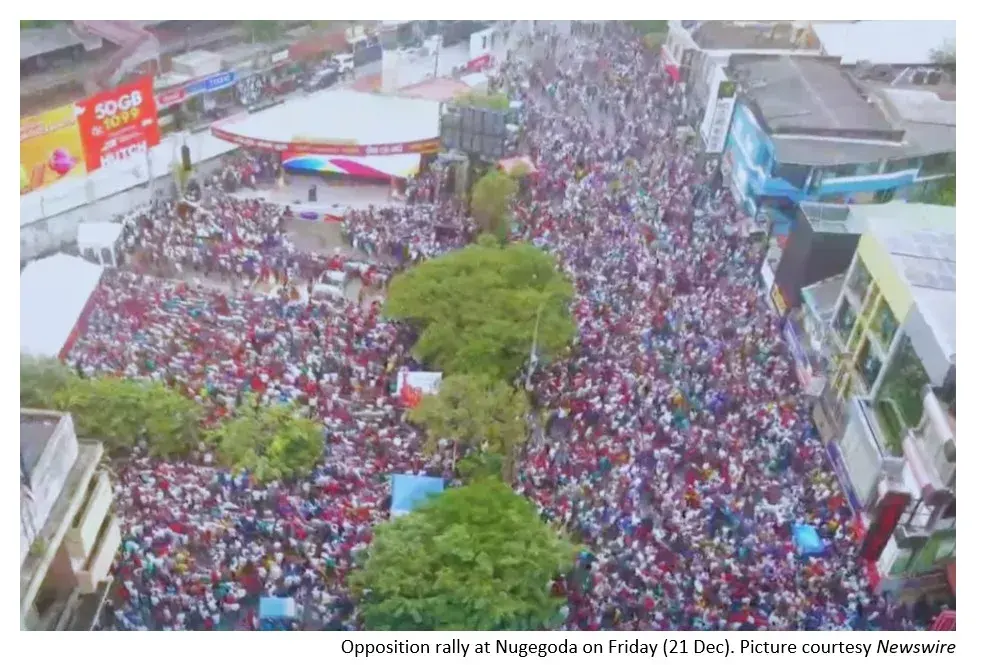
The joint Opposition rally at Nugegoda last Friday has been viewed through different political lenses and various opinions expressed. The organizers of the event would have the public believe that it was a mammoth rally, but the government has sought to belittle it as a damp squib. Both sides cannot be expected to tell the truth for obvious reasons.
Friday’s rally was not as big as the SLPP and its allies made it out to be, but it was no mean achievement for a collective of Opposition parties that have not yet fully recovered from three consecutive electoral defeats. The rally drew a fairly large crowd despite the inclement weather and the government’s hostile actions. It is not easy for a section of the Opposition to mobilize its supporters in large numbers. The SLPP and its allies took a huge gamble, but they were home and dry.
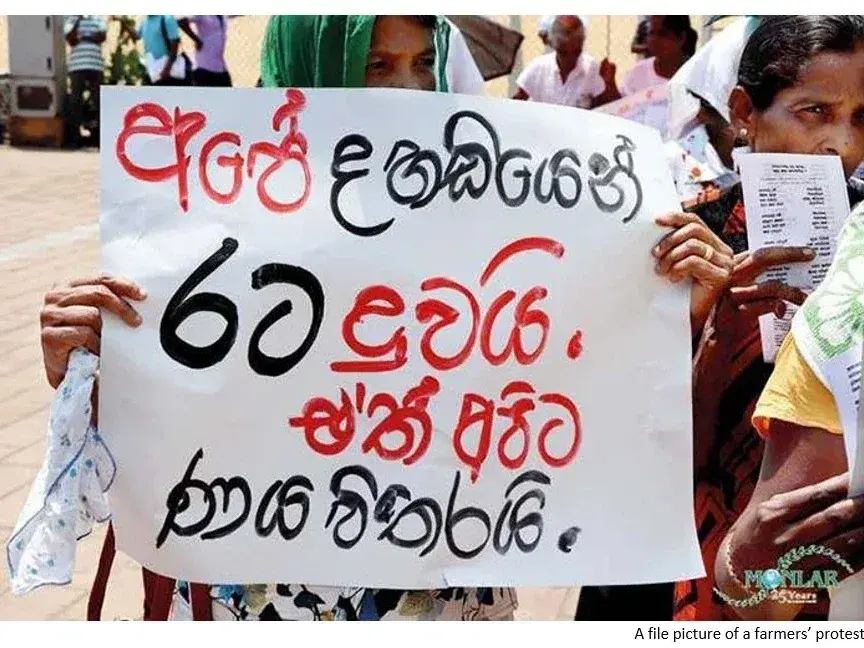
The JVP-led NPP has been carrying out virulent social media attacks on the SLPP and its partners in a bid to turn public opinion against them. Its propaganda was quite effective during its opposition days, but what works for a political party while in opposition does not have the same effect when it is ensconced in power with the anti-incumbency factor weighing on it. Before last year’s elections, the NPP raised people’s expectations more than any other party had done since Independence; it promised to renegotiate the IMF programme, bring down taxes and tariffs to affordable levels, eliminate bribery and corruption and grant substantial economic relief to the public besides introducing what it called a ‘system change’. It has failed to fulfil most of its election promises. Worse, some of its key members have come to be accused of corruption and the abuse of power. Farmers, teachers, university dons, doctors and the Development Officers are up in arms. Teachers and doctors have already threatened strikes. Farmers are demanding the fertilizer subsidy for the current cultivation season and asking the government to make fertilizer freely available. The Development Officers who have worked in state-run schools as teachers for several years are demanding that they be absorbed into the teacher service. It is against this backdrop that the government’s propaganda onslaughts against the Opposition should be viewed.
The government claimed to be unconcerned about the Nugegoda rally. If so, it should have allowed the event to proceed uninterrupted. But there was a blackout in the Nugegoda area during the rally, and the police removed loudspeakers on the pretext of preventing disturbances to the GCE A/L candidates. The Opposition says the government was behind the power outage, and President Anura Kumara Dissanayake held a rally in Tangalle on Thursday, but the police allowed loudspeakers to be used at that event although there were examination centres in the vicinity. Bundles of grass were also hung on lampposts in different parts of the country in a bid to insult those who attended Friday’s rally. It was obvious that the JVP/NPP activists had one so. Those tactics are not of recent origin. Successive governments have employed them to harass and ridicule their political opponents, but the NPP came to power promising a clean break from that rotten political culture.
It will be a mistake for the organizers of last Friday’s rally to overestimate their strength. Crowds do not necessarily translate into votes in elections. The viable political party in an election fray draws huge crowds, but the party that draws huge crowds does not necessarily win. Sri Lankan political parties are known to bus their supporters to their rallies from all parts of the country to inflate crowds at their political events for the camera. One may recall the massive crowds at election rallies addressed by Sirimavo Bandaranaike in the run-up to the 1977 general election despite his party’s unpopularity. The SLFP suffered a crushing defeat, and the UNP obtained a five-sixths majority in the parliament. In 2015, the then President Mahinda Rajapaksa’s election rallies were well attended and considered larger than those held in support of his main rival, Mathripala Sirisena, but the latter emerged the winner.
The NPP has said it will hold a bigger rally than the one held by the Opposition on Friday. It no doubt will be able to do so, as the ruling party. The JVP is known for its organizing skill and putting on shows of strength. It held impressive political events even after its national vote share had plummeted to a meagre 3 percent. But crowds are only a single indicator of the political strength of either the government or the Opposition. There are other indicators, the main being their performance in elections. The NPP government has decided against holding the Provincial Council (PC) elections despite a promise it has made in its election manifesto to hold them within one year of forming a government. This is seen as a sign of the government’s weakness; no ruling party delays elections if it is confident of winning them. The NPP can hold the PC polls even in early 2026. All it has to do is to amend the PC Elections Act with the help of its two-thirds majority in the parliament. In fact, that task requires only a single majority. The Opposition has been urging the government to legislate for the PC polls to be held under the Proportional Representation system, so that the question of the completion of the delimitation of electoral boundaries does not arise, but the latter has ignored that call. The NPP has lost budget votes in dozens of local councils under its control. This is a huge setback for any ruling party with a two-thirds parliamentary majority. The Opposition parties have joined forces to defeat the NPP, and succeeded in winning most of the cooperative society elections held so far.
The Opposition parties may be able to muster more votes than the NPP in local councils and cooperative society elections, but the anti-government vote will be split unless they contest future elections as a common front. Otherwise, the NPP will stand to gain. Friday’s rally at Nugegoda brought the differences and competing ambitions among the key Opposition figures to light.
It is no longer plain sailing for the government, which has had to shore up its approval rating and is struggling to retain the support of the NPP’s core support groups. The Opposition parties have a long way to go before winning back enough popular support to turn the tables on the NPP. So, neither the government nor the Opposition has any reason to be on cloud nine.
RELATED NEWS
View all
Politics by Vishvanath
Has 22A become the govt.'s Catch-22?
Aug 27, 2026
Politics by Vishvanath
22nd Amendment: A huge political gamble for govt.
Aug 21, 2026
Politics by Vishvanath
Move to raise retirement ages of judges: Options before govt.
Aug 05, 2026
Politics by Vishvanath
‘Cockroach’ uprising and echoes of Aragalaya
Jul 26, 2026