Current Affairs
Radical Islamist power centres in South Asia
By P.K.Balachandran
Colombo, October 22- Domestic and regional political changes are facilitating the re-emergence of radical Islamic groups as power centres in Pakistan and Bangladesh.
A tentative revival of similar groups cannot be ruled out even in India, which is officially secular but where Hindu majoritarianism is the dominant creed.
Amidst Gen Z-led revolutions and cross-border conflicts, radical Islamist groups are again coming to the fore. These groups draw sustenance from political changes in their countries as well as developments in South Asian politics.
Most Pronounced in Pakistan
The revival is most pronounced in Pakistan. Pakistan has a long history of association with radical Islamic groups. They have been influential since the country was founded in 1947 and named “Islamic republic of Pakistan”. In the early days, Islamic radicals in Pakistan laid stress on the marginalization and persecution of the Ahmadiyas, a sect considered heretical by mainstream Muslims.
The Islamic groups were subdued under Gen.Ayub Khan’s rule as Pakistan was then on a developmental path. But the illeffects of the war with India in 1965 and the secession of East Pakistan in 1971 (due to a dispute over the official language and Bengali pride), led to the belief that it was due to the waning influence of Islam that the country was weak. Therefore, during the regime of the military dictator Gen.Zia ul Huq (1977-1988), Islamization became State policy.
Gen. Zia’s Islamic drive coincided with the Afghan Jihad against Soviet overlordship (1979-1989). Pakistan enthusiastically participated in the Afghan Jihad which was also supported by the US.
The anti-Soviet Jihad which later became an anti-American Jihad (2001-2021) spawned Islamic radical groups in Pakistan. The Pakistani State used these groups in its clandestine operations against India to avenge the defeat at the hands of India in East Pakistan in 1971, and also to seize Kashmir.
There was a non-religious reason also for Pakistan’s involvement in the Afghan Jihad. Having control over Afghanistan would give it “strategic depth” which Pakistan lacked because of the layout of the land. The lack of strategic depth would be a potential disadvantage in a war with India.
Given the legitimacy bestowed on them by successive Pakistani governments, the Islamic radical groups acquired a politico-religious agenda of their own, often to the discomfiture of the governments in Islamabad. The Islamic groups started demanding full implementation of Sharia law and stricter enforcement of the harsh Blasphemy law.
Increasing confrontations with India after 1971, created more space for Islamic extremist groups in Pakistan, which in turn, was used by the State as proxies to carry out attacks against Indian miliary and civilian targets to force New Delhi to negotiate on Kashmir.
Thus, a strong commonality of interest developed between the State and the radical Islamic groups.
To Pakistan’s dismay, after it took over Afghanistan in 2021, the Afghan Taliban turned against it. The Afghan Taliban suspected that Islamabad was trying to be the Big Brother. Also, in Taliban’s view, Pakistan was useful only to fight a war and was of little use in peacetime when priority shifts to economic development. In peacetime, it would be more advantageous to cultivate countries like India, China and Russia which could help rebuild the war-devastated country.
Meanwhile, Pakistan was also seeing the rise of domestic ethno-based Islamic radical groups like the Tehrik-i-Taliban Pakistan (TTP). The TTP has support in Pakhtun-populated areas in Pakistan like the Khyber Pakhtunkhwa province bordering Afghanistan. The TTP’s Pakhtuns and the Pakhtuns in Afghan Taliban are the same.
The TTP is modelled after the Afghan Taliban and is seeking to make Pakistan a Sariah-run country like Afghanistan. Because of this, the TTP has been clashing with the Pakistani army. It is a major ideological, political and ethnic challenge to the Pakistani State.
Islamabad sees the TTP as a proxy of the Afghan Taliban and the Kabul government, a link Kabul and the Afghan Taliban stoutly deny.
The matter got complicated by the Pakistan-Afghanistan dispute over the Durand Line, as the border between the two countries is known. The Afghan Taliban and Kabul do not recognise it as the international border claiming that it divides the Pakhtun community. The TTP’s stand on the Durand Line is similar to that of the Afghan Taliban.
India Factor in the Revival
It was against this background that the Pakistan-Afghanistan war took place in October. Pakistan scaled up the confrontation by accusing the Taliban of becoming a proxy of India because the Afghan Foreign Minister, Amir Khan Muttaqi, was on a visit to New Delhi when fighting broke out.
In New Delhi, Muttaqi not only supported India’s claim over Kashmir but also accused Pakistan of cross border terrorism against India. Afghanistan supported India in the Pakistan-India war in May this year.
In the midst of the Pakistan-Afghanistan standoff, New Delhi had been cultivating the Taliban government with offers of development projects. It had executed such projects even when Afghanistan was ruled by non-Taliban Presidents like Hamid Karzai and Ashraf Ghani. As per the dictum “one’s enemy’s enemy is a friend” Afghanistan and India built a strong relationship much to Pakistan’s chagrin.
The Deoband Connection
Adjusting to the emerging circumstances, India modified its hostility towards radical Islamic groups and encouraged the conservative Darul Uloom Islamic seminary in Deoband (North India) to host Muttaqi. Deoband rolled out the red carpet to Muttaqi, awarded a title and also stressed the close historical links between Deoband and Islamic seminaries in Afghanistan.
India’s clever use of Islamic links sent shockwaves through Pakistan which promptly accused India and the Taliban of having an opportunistic alliance against it. In India, opinion was divided with liberals and leftists opposing the alliance on the grounds that it could give a boost to Islamic radicalism.
In another development, a Pakistani Islamic radical group called Tehreek-e-Labbaik Pakistan (TLP) saw a revival. The TLP is now trying to coerce the government to take an aggressive stand on the Gaza issue. It threatened to march on Islamabad. The government branded it as a terrorist organization and banned it. The TLP had previously led violent blasphemy-related protests and attacked Christians and Ahmadiyas.
Jamaat’s Revival in Bangladesh
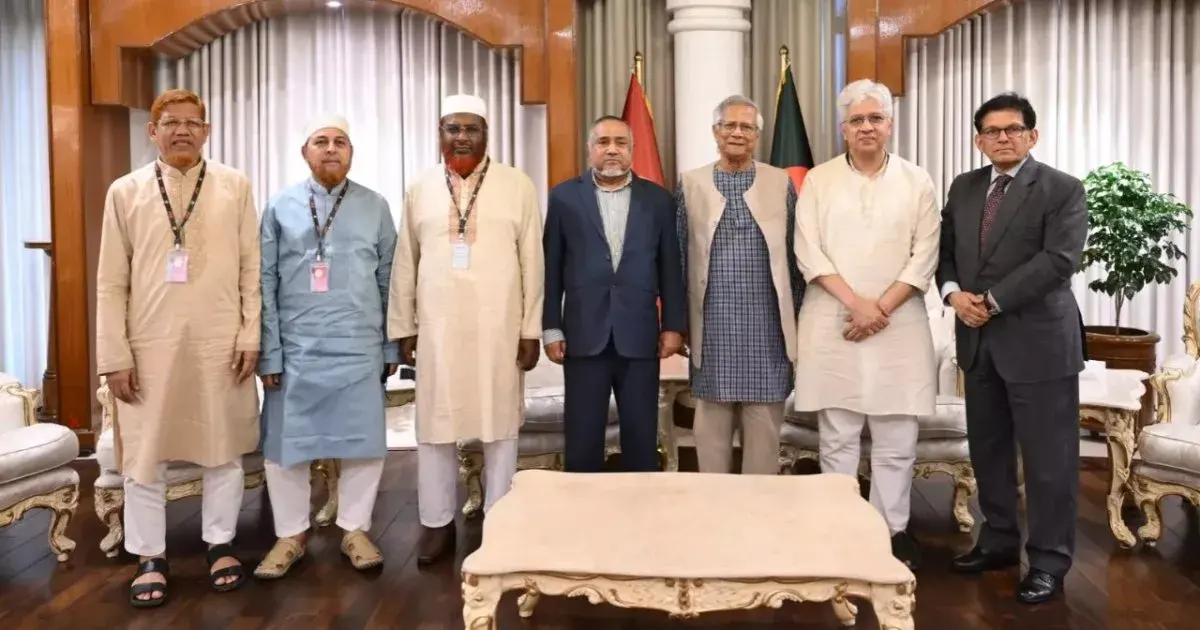
In Bangladesh, the Interim Government led by Prof. Muhammad Yunus lifted the ban on the radical Islamist Jamaat e- Islami (Jamaat) following the ouster of Sheikh Hasina’s government in August 2024.
The Jamaat had participated in the July-August revolution in alliance with Gen Z from the universities and won a place in the post-Hasina interim government.
Meanwhile, the Jamaat rehabilitated itself by living down its pro-Pakistan image and watering down its hardline on the tenets of Islam. It adopted an inclusive and progressive rhetoric. This new orientation reflected its desire to be a “Leftist Islamic” party, blending Islamic values with social and economic equity, inclusivity, and broader citizenship rights.
Shafi Mohammad Mostofa says in The Diplomat that the Jamaat’s hide-bound ideology ill-fitted a typical Bangladeshi’s mindset which was oriented to Sufism, a mild and syncretic Islam.
On gender issues, the Jamaat has attempted to strike a balance between Islamic tradition and progressive values. While the party remains cautious in its stance, it has distanced itself from more conservative models like those seen in Afghanistan or Pakistan, arguing instead for a “Bangladeshi approach” that respects both Islamic and cultural traditions, Mostafa adds.
Another significant factor hampering the Jamaat’s wider acceptance was that it had aligned with Pakistan and other forces opposing Bangladesh’s independence in the 1970s. Some of its leaders were even convicted of war crimes and executed by the Hasina’s regime for their role during the Liberation War. The Jamaat is trying to live down this image too.
Jamaat’s image makeover has helped increase its popular support base. The new students’ party, National Citizens Party (NCP), that was the vanguard of the July 2024 Gen Z revolution, is now in an informal alliance with the Jamaat. The slogan “Islam is the solution for Bangladesh’s ills” is catching on, according to Mostafa.
However, there is a lot of criticism in India and from the Sheikh Hasina’s party, the Awami League, about Jamaat’s attacking Hindu and Sufi shrines. But the head of the Interim government Muhammad Yunus contends that such attacks had taken place only in the past as part of the peoples’ revolt against Hasina. It subsided once the revolutionary fury died down.
However, it remains to be seen as to how the Jamaat will behave as a political party and what its role will be when a new Bangladesh constitution is drafted either before or after the parliamentary elections in February 2026.
END
RELATED NEWS
View all

Current Affairs
Sri Lankan Presidential pardons- the good and the bad
Sep 11, 2026
Current Affairs
The pros and cons of joining BRICS- the dilemma of Pakistan and Bangladesh
Sep 09, 2026
Current Affairs
Disaster in Nepal gets embroiled in geopolitics.
Sep 08, 2026
Current Affairs
Why Mecca Pact, and what does it imply for its members, Israel and India?
Aug 18, 2026