Current Affairs
Rumours about Imran’s “murder” – sign of a deeper political malaise
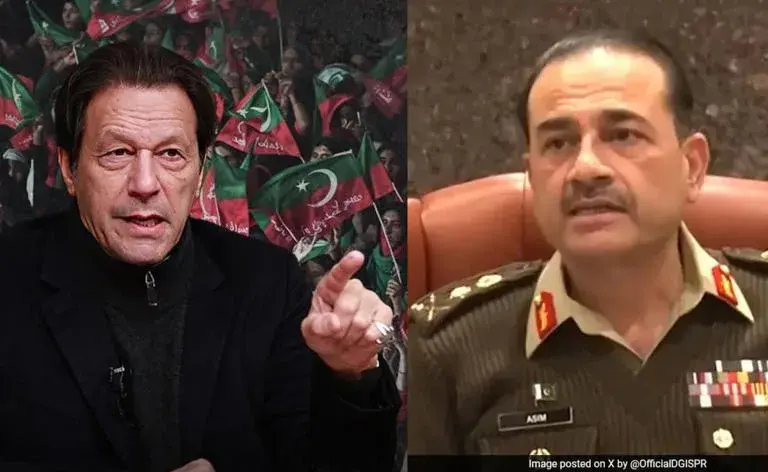
The rumour about the alleged murder of the jailed former Pakistani Prime Minister Imran Khan earlier this week, is a sign of a deeper malady in that country – the uneasy relationship between the country's politicians and its army.
By P.K.Balachandran
Colombo, November 29 – Earlier this week, Pakistan was in the grip of a ghastly rumour that former Prime Minister Imran Khan was murdered in Adiala jail in Rawalpindi where he has been an inmate since 2023.
The frenzy began with the "breaking news" posted by “Afghanistan Times”, which claimed that a “credible source from Pakistan” confirmed to it that Imran Khan was “mysteriously killed in jail, and his body was moved out of the prison." As this spread like wildfire, thousands of Imran’s supporters reportedly stormed the jail.
The rumour was of great concern to Imran’s followers because it came at a time when he was held in solitary confinement and his sisters were staging protests outside the Jail demanding to see him and were manhandled by the guards. Sisters Noreen, Aleema and Uzma Khan alleged that their brother was "brutally assaulted" in the prison, when he complained of maltreatment.
Supporters of Imran pointed an accusing finger at the army Chief Field Marshal Asim Munir who is believed to have all the levers of power in Pakistan in his hands de facto.
Incumbent Prime Minister Shehbaz Sharif came to power through a no-confidence motion against Imran Khan in 2022 allegedly manipulated by the then Army Chief Gen. Qamar Javed Bajwa. And Shebaz Sharif threw Imran into jail on multiple charges, again backed by the Army Chief Gen.Bajwa.
The alleged intention of the powers-that-be is to keep Imran locked up till he seeks pardon and stops criticising the army which is generally termed “The Establishment”. But it is three years since Imran was thrown into prison and there is no sign of his being remorseful.
The dust over the rumour settled when the authorities at the Adiala Jail declared that Khan was alive and that there had been no incident that compromised his safety. A government minister said that Imran has a comfortable bed, access to an exercise machine, and food of his choice from outside.
But leaders of Imran’s party, Pajistan Tehreek-i-Insaf (PTI) demanded that "a transparent and official statement be issued regarding the health, safety, and current status of Chairman Imran Khan.” They declared that they would fight the issue in court as well in the political arena.
A top PTI leader and Chief Minister of Khyber Pakhtunkwa province Sohail Afridi charged that the government was “pushing Pakistan’s strongest political party against the wall” with its leader being discriminated against and his family, party and government in Khyber Pakhtunkwa, being targeted.
He warned that the situation could spiral out of control. “Business as usual will not go on until the PTI founder is allowed to meet his sisters and party leadership,” Afridi added.
A key question which the authorities have not answered is why Imran’s family and partymen are not allowed to see him even for a few minutes when there is a court order of March 2024 allowing the family to see him twice a week? The family members said that they would go to court with a contempt plea.
Army is the Target
Though not explicitly, the PTI is implicitly targeting the army and its chief, Field Marshal Asim Munir, as he is the ultimate Establishment in Pakistan. Pakistan's history since 1947 has been shaped by a dynamic interplay between its Prime Ministers and Army Chiefs, with the latter taking the most important domestic and foreign policy decisions. This complex relationship has led to periods of direct and indirect military rule.
The military’s dominance was formalized with Pakistan’s first military coup in 1958 led by Gen. Ayub Khan. The coup dismantled the order established by the 1956 Constitution and set a precedent for repeated military interventions. Over the decades, Pakistan has witnessed three military coups, in 1958, 1977 and 1999.
Although a parliamentary democracy on paper, Pakistan's Prime Minister is elected by the National Assembly, the military has repeatedly intervened—directly through coups and martial law or indirectly through pressure on the Executive, Judiciary, and the political parties. The army determines who ascends to, remains in, or is removed from offices of Prime Minister and President.
This influence stems from the army's self-perceived role as the guardian of national stability amid chronic civilian instability, corruption, economic woes, and perceived threats from India. Military's interventions have been justified via legal doctrines like the "doctrine of necessity," which courts have historically upheld, allowing extraconstitutional actions.
The army has engineered no-confidence votes, corruption charges, or judicial disqualifications to oust a Prime Minister or install one. What is prevalent in Pakistan is a "hybrid regime" where civilians appear to govern but must align with military interests in foreign policy, security, and budgets.
Due to such distortions, no Pakistani Prime Minister has ever completed a full five-year term. Of the 24 PMs to date, 18 have been removed prematurely, with military fingerprints on most. The army has ruled directly for about 33 of Pakistan's 78 years, stunting democratic institutions and fostering a cycle of instability.
The Pakistani military is not an “intervener” in the political sphere but its “most consistent and powerful occupant”. It functions as the country’s premier institution—a “state within a state”. It is a “garrison state” as political scientist Dr. Ishtiaq Ahmed put it. It has systematically shaped Pakistan’s governance, economy, and foreign policy to serve its own corporate interests says defence expert Dr.Ayesha Siddiqa.
Former Prime Minister Nawaz Sharif of the Pakistan Muslim League (Nawaz) said on Wednesday that the “criminals” who brought Imran Khan to power in 2018 must also face justice. He accused former army chief Gen Qamar Bajwa, and ex-Military Intelligence chief Gen Faiz Hameed of playing a key role in his ouster from Prime Ministership in 2017. Nawaz Sharif had, in the past, fought for civilian supremacy — and paid for it by losing his job.
But his case alone does not provide a holistic view, says “Dawn” in a recent edit. “For decades — well before Imran’s arrival on the political scene — various state institutions played a role in making and breaking governments.
And in the case of individuals, ironically, many of the same elements Sharif had blamed for his ouster were seen to be involved in the fall of Imran’s government and in helping the Shebaz Sharif government to come to power in 2022. Gen Bajwa was army chief when Sharif was sent packing and also when Imran was removed.
“So all such episodes should be examined in detail, and not just viewed through a selective lens,” the edit said and added that it would be better to admit the “bitter truth that the politicians, including those belonging to Sharif’s party, as well as state institutions, including the judiciary, have often played ball with unelected forces to oust rivals through palace intrigues.”
It in noticeable that “Dawn” preferred not to identify the “unelected forces” as these were clearly the men in uniform.
The paper went on to say that it was notable that while Nawaz Sharif bemoaned the meddling of such forces, his own party men, including ministers, sang paeans to the hybrid system.
“Introspection is needed and the political class must reflect on how they themselves create situations that allow non-political forces to seize the levers of power,” the paper said.
The edit recalled that Nawaz Sharif and Benazir Bhutto of the Pakistan Peoples’ Party (PPP) had signed the Charter of Democracy (CoD) in 2006 to strengthen civilian supremacy. That document stated that “no party shall solicit the support of the military to come into power or to dislodge a democratic government”.
But both their parties have ignored this aim, with the result both were victims as well as beneficiaries of the hybrid system.
“Therefore, the need of the times is a new charter and a firmer, consistent and united commitment to restoring the basic tenets and institutions of democracy,” the edit said.
END
RELATED NEWS
View all

Current Affairs
Sri Lankan Presidential pardons- the good and the bad
Sep 11, 2026
Current Affairs
The pros and cons of joining BRICS- the dilemma of Pakistan and Bangladesh
Sep 09, 2026
Current Affairs
Disaster in Nepal gets embroiled in geopolitics.
Sep 08, 2026
Current Affairs
Why Mecca Pact, and what does it imply for its members, Israel and India?
Aug 18, 2026