Current Affairs
Trump and Modi can’t bridge differences despite good personal chemistry
By P.K.Balachandran
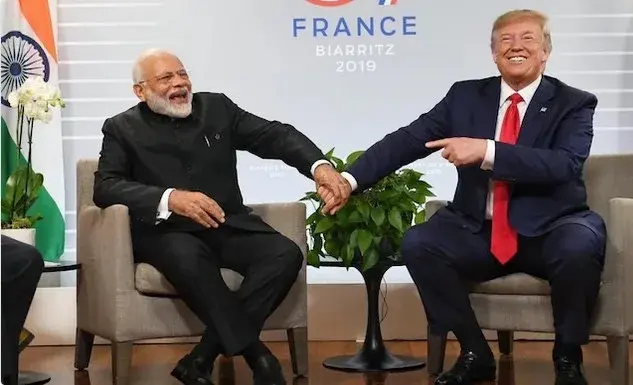
Colombo, October 11 - US President Donald Trump and Indian Prime Minister Narendra Modi enjoy good personal chemistry, and yet, they have been unable to bridge the gulf between their national interests.
The tariff issue, with Trump pitching duties on Indian goods at 50%, and India not opening up some sectors to US products, have stymied trade talks. Trump’s bid to mediate between warring India and Pakistan has floundered due to India’s non-cooperation. Even Trump’s diplomatic appointments relating to India have left a bitter taste in Indian mouths.
On the Modi’s 75 th. birthday on September 17, Trump posted on Truth Special a message saying “Just had a wonderful phone call with my friend, Prime Minister Narendra Modi. I wished him a very Happy Birthday! He is doing a tremendous job. Narendra: Thank you for your support on ending the War between Russia and Ukraine! President DJT.”
In response, Modi posted on X - "Thank you, my friend, President Trump, for your phone call and warm greetings on my 75th birthday. Like you, I am also fully committed to taking the India-US Comprehensive and Global Partnership to new heights. We support your initiatives towards a peaceful resolution of the Ukraine conflict."
After Trump got the Israelis and the Hamas to agree to a ceasefire and an exchange of prisoners, Modi said on X that he congratulated his “friend, President Trump on the success of the historic Gaza peace plan.” Modi further said that the two leaders “reviewed the good progress achieved in trade negotiations and agreed to stay in close touch over the coming weeks.”
Although Modi claimed that “good progress” had been made on the tariff and trade talks, there is no inkling yet as to where the gaps were narrowed. While Trump can play for a longer time, Modi faces a time constraint because his Bharatiya Janata Party (BJP) will be facing a tough election in Bihar in November where a bad deal with the US on agricultural imports could ruin his prospects.
Appointment of Sergio Gor
The Indian establishment has not been happy with Trump’s diplomatic appointments relating to India. Trump appointed Sergio Gor as Ambassador to India as well as a Special Envoy for Central and South Asia. This which meant that Gor’s jurisdiction would not be India-specific, a fact that hurt Indian egos. The Indian media expressed dismay over the bunching of India with many other countries, especially rival Pakistan.
Former Indian diplomats pointed out that Gor did not measure up in terms of qualifications and experience compared to many former US envoys to India, some of whom were noted academics and scholars. Former Ambassador to the US Nirupama Rao said that Gor had no diplomatic experience and that his USP was his personal loyalty to Trump.
Trump’s choice of Gor and the portfolio he gave him clearly showed that he downgraded India. Gor is not exclusive to India. New Delhi is now lumped with Islamabad, Kabul, Dhaka and several Central Asian countries. Some Indian foreign policy experts worry that this may indicate continued US interest in mediating between India and Pakistan on Kashmir and terrorism. India is stubbornly against foreign mediation.
But some saw a silver lining. The Hindu quoted Mukesh Aghi, President and CEO of the US India Strategic Partnership Forum, as saying that Gor will be able to speak directly to President Trump and not through the State Department. Aghi thought that Gor might be able to settle some knotty issues through his personal relationship with Trump.
Appointment of Paul Kapur
The appointment of Dr. S.Paul Kapur as US Assistant Secretary of State for South Asia is highly significant, though it might not be to the liking of the policy makers in New Delhi.
Kapur is an acknowledged expert on nuclear warfare and also India-Pakistan military conflicts. This is noteworthy in the context of Americans’ worry over nuclear armed India and Pakistan (each with 170 nuclear warheads) using nuclear weapons in their wars, which have been quite frequent. Kapur being an expert on India-Pakistan armed conflicts could supply Washington with accurate assessments based on solid analysis.
In May this year Trump said that he stopped India and Pakistan fighting because it could have "turned out into a nuclear disaster." Trump added that the US could not trade with those who could potentially use nuclear weapons.
Kapur’s Observations
Kapur’s take on the possibility of a nuclear war between India and Pakistan is based on a deep study over years. In his paper “India and Pakistan’s unstable Peace,” written when he was Visiting Scholar at Stanford University’s Centre for International Security and Cooperation, he argues that the threat of use of nuclear weapons has been, and will continue to be, made in India-Pakistan conflicts but neither side will use them.
The most interesting observation he makes is that though the nuclear option will not be exercised by Pakistan, it gives that country the courage to go for a conventional war with India or stage terror attacks on Indian targets, to attain its objectives in Kashmir.
The basis of the chutzpah is that the threat of a nuclear war will force India to sue for peace. Threat of such a war will also get the US and its allies to press India to go for a settlement on Kashmir. In other words, for Pakistan, nuclear capability is an instrument of psychological coercion rather than an instrument of destruction, Kapur says.
He points out that Pakistan, which was relatively inactive militarily after its defeat in East Pakistan at the hands of India in 1971, became militarily belligerent after it acquired nuclear weapons in 1998. Pakistan launched the Kargil operation in 1999 because it had nuclear weapons.
The then Pakistan army chief Gen. Pervez Musharraf had launched a daring plan to occupy scores of places on mountain heights in Kargil to disrupt Indian communication lines in Kashmir and force India to come to the negotiating table. He had seen no need to actually use the nuclear weapon because, in his view, India would have sued for peace fearing a Pakistani resort to nuclear warfare if India were to deploy all its conventional might to throw the Pakistanis out.
However, what happened was contrary to Musharaff’s expectations. The Indians used conventional forces in a massive fashion to neutralize the Pakistani pickets. And again, to his surprise, the US, fearing a nuclear war, intervened on India’s behalf and not Pakistan’s. Prime Minister Nawaz Shariff was summoned to Washington to be told to call off the Kargil misadventure.
The then Indian Minister of Defence George Fernandes told Kapur that if Pakistan had used its nuclear arsenal, India could have done the same and caused very much more damage. Pakistan was aware of this and the US feared it, hence its intervention.
After the Pakistan-based Jaish-e-Mohammed attacked the Indian parliament in December 2001, the Indian army did not attack Pakistan but adopted the strategy of massing troops on the border threatening a large-scale invasion. Pakistan responded in kind with its own mass mobilisation. But, even as the two armies faced eye ball to eye ball, there was no fighting as both were aware that war (with or without nuclear weapons) would have been terrible for both.
The US Secretary of State Condoleezza Rice directly intervened and asked India not to retaliate when Pakistani terrorists bombed several targets in Mumbai in September 2008.
Therefore, a number of factors combined to restore peace on the border between India and Pakistan and the threat of using nuclear arms was only one of the factors.
In the case of the May 2025 Operation Sindoor, it was the fear of nuclear escalation that brought an American intervention into play. A ceasefire was brought about within four days. The US role was acknowledged by Pakistan but stoutly refuted by India. This hurt President Trump whose showed his displeasure with India through a series of decisions meant to put the Indians in their place.
END
RELATED NEWS
View all

Current Affairs
Sri Lankan Presidential pardons- the good and the bad
Sep 11, 2026
Current Affairs
The pros and cons of joining BRICS- the dilemma of Pakistan and Bangladesh
Sep 09, 2026
Current Affairs
Disaster in Nepal gets embroiled in geopolitics.
Sep 08, 2026
Current Affairs
Why Mecca Pact, and what does it imply for its members, Israel and India?
Aug 18, 2026