Politics by Vishvanath, Cover Story
Uprisings and need for safety valves to release public anger
by Vishvanath
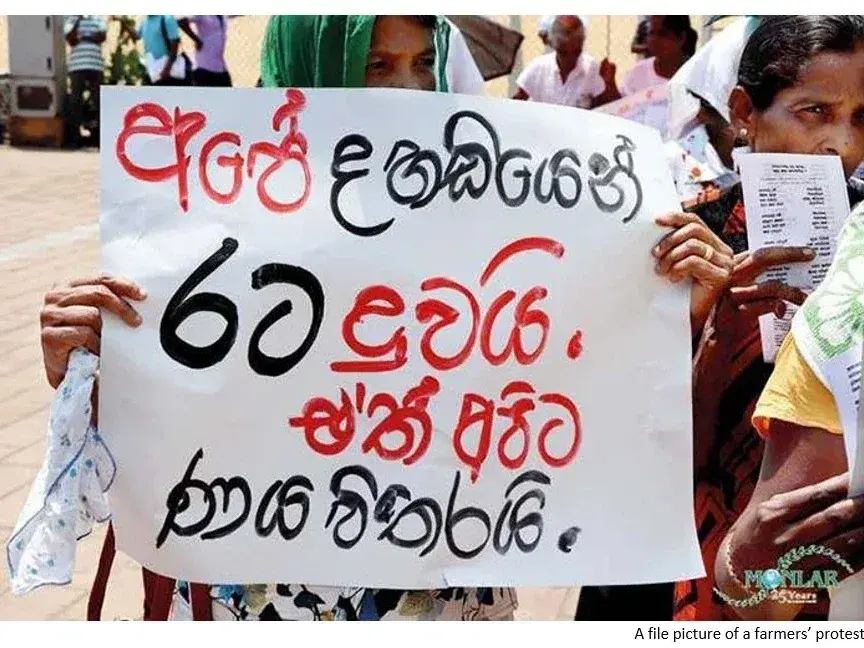
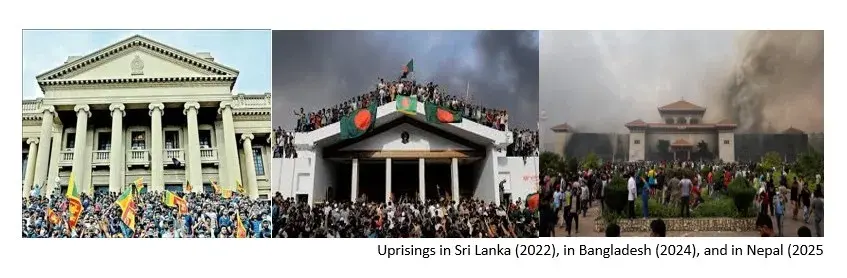
Much has been spoken about the phenomenon of youth-led uprisings in this part of the world. Sri Lanka, Bangladesh and Nepal have already experienced them, in 2022, 2024 and 2025, respectively. They are generally thought to be spontaneous events caused by the pent-up anger of politically active youth, who have lost faith in traditional means of protest and are driven by anti-politics. People’s resentment is no doubt a common denominator of all three South Asian uprisings we have witnessed since 2022 Aragalaya here, but there is a need for a serious discussion on this phenomenon other than the factors, such as youth resentment, and immediate triggers—unemployment, economic hardships and social media bans.
A vital aspect of the aforesaid uprisings has gone uninvestigated; it is alleged foreign involvement. It may be recalled that in March 2022, the then Speaker Mahinda Yapa Abeywardena told the parliament that some foreign powers had pressured him to take over the presidency in violation of the Constitution, but he had rejected their demand out of hand. “The objective of those who made that demand was to create another Libya or Afghanistan here. They did not want to resolve the crisis or restore law and order to protect this country,” the Speaker said, after a no-faith motion against him had been defeated. He claimed that there had been both local and foreign forces behind that move. “I was asked to name a Prime Minister and a Cabinet of ministers and rule the country. “However, I was determined to uphold democracy,” the Speaker said, adding that he had been surprised to see, among the proponents of the no-confidence motion, some of those who asked him to become the President of the country unlawfully. “When I rejected their call, they resorted to intimidation. There were threats too. Among those who exerted pressure on me were leading Bhikkhus and leaders of other religions,” he said.
Curiously, there has been no campaign for an investigation into that revelation.
In August 2004, ousted Bangladesh Prime Minister Sheikh Hasina, after fleeing to India, accused the US of having orchestrated her ouster as a result of some disputes over Saint Martin Island. The US strongly rejected her allegation. Interestingly, the Indian media has recently reported that ‘an increase in the United States military activities in Bangladesh's strategically placed Chittagong area, located close to borders of India and Myanmar, has raised eyebrows as it may have implications beyond Bangladesh’.
Uprising may topple regimes that fail to live up to people’s expectations and suppress democratic dissent, but they do not necessarily bring about lasting positive outcomes. In some countries, where people rose against corrupt dictators and ousted them, have reverted to the status quo ante immediately afterwards or later. The Philippines serves as an example. Filipinos took to the streets in 1986 and got rid of President Ferdinand Marcos, a dictator notorious for abusing power, suppressing democracy and amassing colossal amounts of ill-gotten wealth at the expense of the public; their struggle came to be dubbed ‘People Power’. Not even the US could protect Marcos, who was its ally; he and his family had to flee. But 39years later, the Filipinos elected the ousted dictator, Marcos’ son, nicknamed Bongbong as their President; it has been reported that his only qualification for seeking election to the highest post was that Marcos was his father! He won an election landslide in 2022 and became Rodrigo Duterte’s successor. His was a stunning comeback, which marked the return of the Marcos political dynasty.
In today’s world, a mainstream Opposition can play a vital role in bringing down governments or tame them only through electoral means. It can launch protest campaigns, but unlike in the past, there has emerged a situation where others, driven by anti-politics, can outdo the democratic Opposition in protests, as they are bound by no rules of engagement and therefore can attract the radical youth, who need quick results and are averse to mainstream politics. In Sri Lanka, Bangladesh and Nepal, protesters overtook the mainstream Opposition parties by mobilizing resentful people mostly via social media for overthrowing unpopular governments. This upsurge of anti-politics in the region augurs ill for democracy, as it erodes the foundations of democratic institutions and tends to unleash anarchical forces.
An extra-parliamentary regime change is indicative of a severe erosion of public faith in democratic process in the country where it occurs. It results from a massive pressure build-up in a polity characterized by pent-up public resentment. We saw people’s anger well up for years during the dysfunctional Yahapalana government (2015-2019) and incompetent SLPP administration, which totally mismanaged the economy afterwards. In Sri Lanka, only the President, the Prime Minister and the Cabinet were ousted in 2022, and nothing was done in violation of the Constitution.
There is a saying that the cure for the ills of democracy is more democracy. So, it is incumbent upon the countries, especially in this region, to adopt remedial measures to eliminate the factors that give rise to violent uprisings that weaken democracy. Besides addressing the issues affecting the public and respecting dissent, an effective way of restoring public faith in the democratic process is canalizing people’s anger, which otherwise tends to spill over on streets by making opportunities available for an electorate to have its voice heard between elections, without having to wait for five or six years. Introducing midterm elections may help provide a vent for pent-up anger and pressure in a polity. There is also a need to ensure the predictability of elections; the postponement of elections has a deleterious effect on democracy, and gives a fillip to anti-politics, which drives the public to extreme actions.
Political thinkers have pointed out several key benefits that accrue to an electorate from midterms. Some of them are as follows: Democratic check on power: Midterm elections enable the public to keep the powers that be reminded that their authority is not absolute but conditional on popular support. Public opinion barometer: Midterms provide the electorate with an opportunity to express their opinion about the performance of the ruling party or government without having to wait until the next general or presidential election. Accountability in governance: Midterms help keep rulers on their toes. Corrective function: In case a government drifts away from its agenda endorsed by the people, midterms cause them to make course corrections. Balance of power: In many systems, midterm elections alter the composition of legislatures, curbing excessive dominance of the executive branch and ensuring healthier checks and balances. The US serves as an example. Encouragement of participation: Midterms promote citizens’ participation in the electoral process between major elections, reinforcing the culture of active democracy. Signal to rulers: A poor performance at midterms can serve as a caution to governing leaders, reminding them that failure to listen may cost them power at the next full election.
Another mechanism that can be put in place to release public anger safely is the recall system, which is however not possible under the Proportional Representation system, which does not provide for by-elections. Following the 2009 MPs’ expenses scandal that rocked the British Parliament, the UK adopted the Recall of MPs Act in 2015. Recall is a process that allows voters to remove an elected representative between elections. In the UK, only the MPs in the House of Commons can be recalled. Six recall petitions have been held to date. Four were successful, one failed and one was terminated early. There has been a campaign for laws providing for the recall of public officials as well in the UK.
The need for urgent measures to rectify flaws in democracy responsible for chaotic situations where the people resort to extra-parliamentary means to overthrow governments cannot be overstated.
RELATED NEWS
View all
Politics by Vishvanath
Has 22A become the govt.'s Catch-22?
Aug 27, 2026
Politics by Vishvanath
22nd Amendment: A huge political gamble for govt.
Aug 21, 2026
Politics by Vishvanath
Move to raise retirement ages of judges: Options before govt.
Aug 05, 2026
Politics by Vishvanath
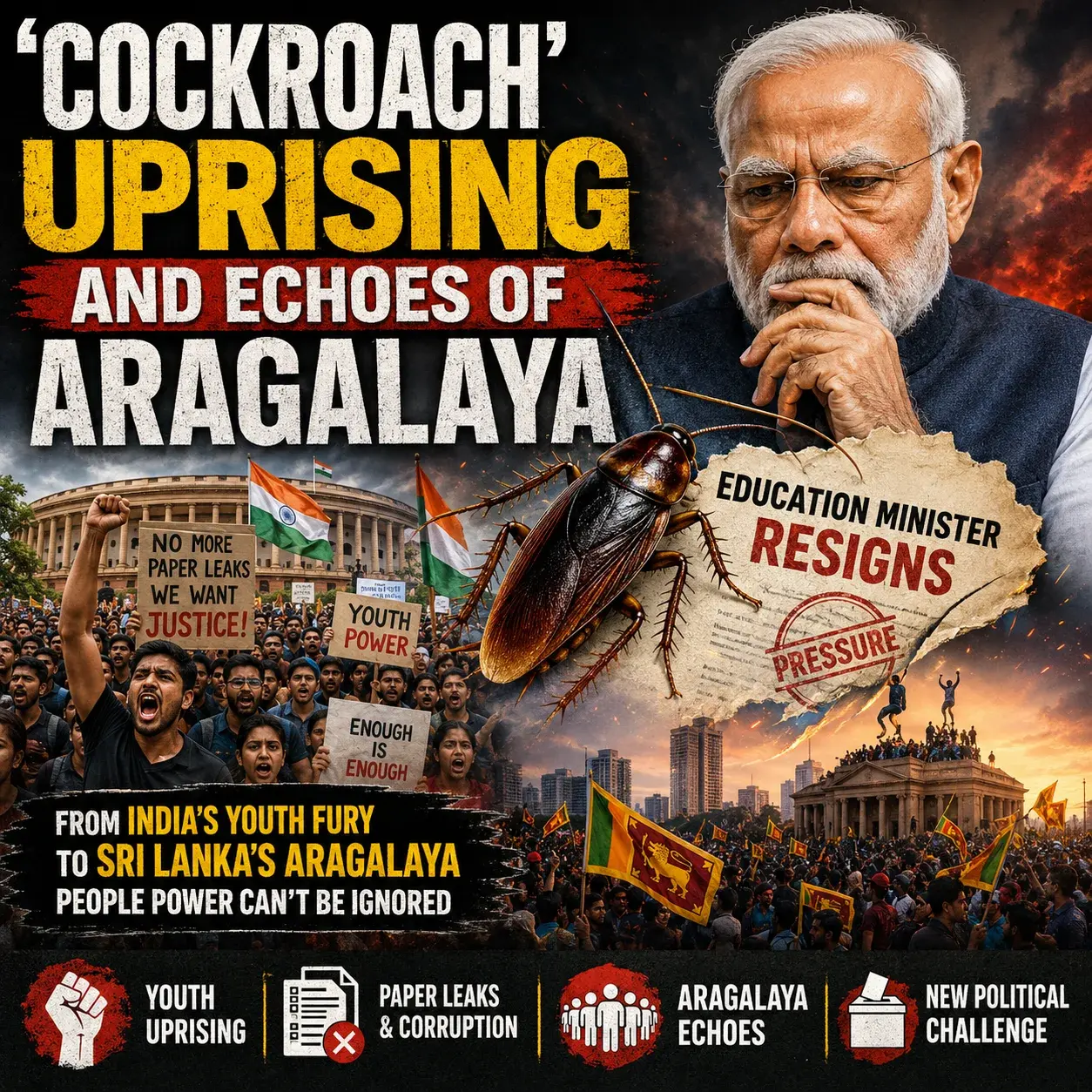
‘Cockroach’ uprising and echoes of Aragalaya
Jul 26, 2026