Politics by Vishvanath, Cover Story
War on drugs and prospects of AKD’s re-election bid
By Vishvanath
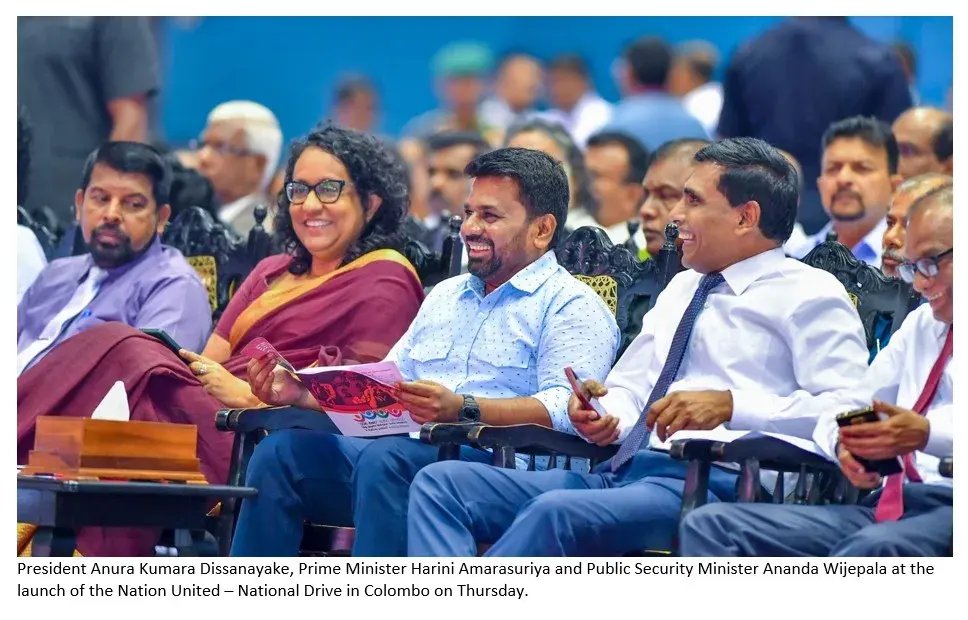
The government launched its anti-drug operation, ‘Nation United – National Drive’ in Colombo on Thursday. A large number of politicians, diplomats and religious leaders attended the event, where everybody, including President Anura Kumara Dissanayake, the prime mover of the initiative, took an oath to fight the drug menace with might and main and protect the country’s children and the youth. Speaking at the event, President Dissanayake said victory in the war on drugs was certain.
President Dissanayake went ballistic, issuing a dire warning to the rogue elements in the police, the military and other state institutions. He said they would be made to face the full force of the law: “Some immigration officers have issued passports to underworld leaders. Because of such actions, the state has become vulnerable to decay. Though not as strong as the official state, the underworld has built a parallel system of power. This black structure must be destroyed. There cannot be two states in one country — only one state can exist, one established by the democratic will of the people ….
“Some of the firearms used by these groups come from our own state weapon stockpiles. Reports show that 73 T-56 rifles went missing from army camps — 35 have been recovered, but 38 are still in criminal hands. Even a senior army colonel has been found supplying ammunition in exchange for money. Some police officers have sold their own weapons and fled. These are state-owned firearms. The question is: how did they end up with armed gangs? This shows that organized groups, empowered by financial might, have managed to penetrate the state machinery. We cannot continue to ignore or hide this situation any longer.”
Most of the concerns and sentiments expressed by President Dissanayake in his speech on Thursday must have struck a responsive chord with the public, troubled by the rise of the narcotics Mafia, which preys on children and the youth. But can’t that goal be achieved without a political circus? This is the question the Opposition has asked. Effects of mega events such as the one in Colombo on Thursday fizzle out and crime-busting operations lose their steam with the passage of time, as has been our experience. The previous government launched ‘Operation Yukthiya’ with the ambitious goal of freeing the country from crime and drugs, under the leadership of President Ranil Wickremesinghe, but that initiative did not yield the intended results, apart from some much-advertised arrests and seizure of drugs. This fact is borne out by the fact that massive hauls of drugs have since been taken into custody, and there has been a spate of underworld killings.
The proof of the pudding is said to be in the eating. So, the success of the ongoing anti-drug campaign will be determined by its outcome, and not publicity it receives. We discussed in a previous comment how President Maithripala Sirisena had used a campaign against narcotics and organized crime to improve his approval rating and shore up the prospects of his re-election. After being sworn in as President, Sirisena made a solemn pledge not to seek a second term, but it was obvious that he was planning to contest the 2019 presidential election, and was using his anti-narcotics drive to prepare the ground for it. He had underworld kingpin Makandure Madush brought back from Dubai, where the latter was arrested together with some other criminals. Much to Sirisena’s dismay, the National Thowheed Jamaath carried out the Easter Sunday terror attacks in April 2021, shattering his re-election dream. He had overcome the so-called wimp factor by taking on the underworld, but the unexpected happened and he was held accountable for the state’s failure to prevent the terror attacks despite repeated warnings of them.
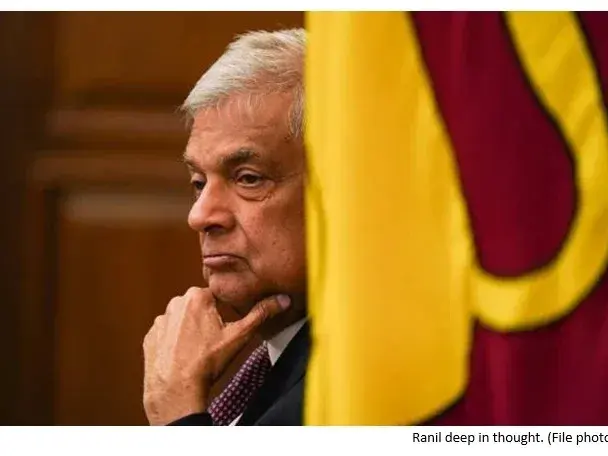
President Sirisena had the economy on an even keel, but miserably failed on the national security front, and all what he had gained from his successful war on drugs was lost overnight so much so that he even did not dare contest the 2019 presidential election. Gotabaya Rajapaksa cashed in on the situation, came forward as the SLPP’s presidential candidate, won handsomely and paved the way for the 2019 regime change and the SLPP’s spectacular win in the 2020 general election. National security was his long suit, and there were no terror strikes or an upsurge in underworld activities as such under his watch. He also conducted a very successful anti-Covid-19 campaign and a vaccination drive to save lives. But he bungled the economy, causing it to collapse and triggering widespread protests that led to his ouster. His successor, Ranil Wickremesinghe, straightened up the economy to a considerable extent, and Operation Yukthiya had his blessings, but he lost the 2024 presidential election very badly. President Dissanayake has not been able to fulfil the NPP’s promise to turn around the economy in double-quick time and provide substantial relief to the public. He and his government are merely continuing what the SLPP-UNP government did, at the behest of the IMF and the World Bank. They, too, have had to make unpopular decisions to fulfil IMF loan conditions to keep the economic recovery efforts on track. Dissanayake has also emulated Sirisena and Wickremesinghe where public security is concerned, as evident from much-publicized anti-narcotics operations and the grand show to mark its launch, which could be considered the beginning of his re-election campaign.
The biggest challenge before Dissanayake is to maintain the momentum of his anti-narcotics drive and show results while developing the economy and granting relief to the public. This is an uphill task. The International Monetary Fund (IMF) has revised Sri Lanka’s 2026 growth forecast down to 3.1% from 3.5%, citing the economy’s return to its long-term trend following a sharp post-crisis rebound. IMF Asia and Pacific Department Deputy Director Thomas Helbling has said the downgrade does not indicate renewed weakness but rather a normalisation after an exceptional recovery. However, the fact remains that it will be a daunting task to achieve a higher growth rate, which is a prerequisite for replaying external debt in earnest from 2028 if Dissanayake is to face the next presidential election confidently. Is too early to say whether Dissanayake will succeed in his endeavour.
RELATED NEWS
View all
Politics by Vishvanath
Has 22A become the govt.'s Catch-22?
Aug 27, 2026
Politics by Vishvanath
22nd Amendment: A huge political gamble for govt.
Aug 21, 2026
Politics by Vishvanath
Move to raise retirement ages of judges: Options before govt.
Aug 05, 2026
Politics by Vishvanath
‘Cockroach’ uprising and echoes of Aragalaya
Jul 26, 2026