Politics by Vishvanath
Politics and religion
By Vishvanath
There is hardly anything that Sri Lankan politicians do not make use of to gain political mileage. They do not even spare religion, religious leaders and places of worship. This practice, however, is not of recent origin; its beginnings have been lost in the mists of time.
Globally, kings and emperors used religion to facilitate and justify conquests and consolidate their power in the captured territories. They also resorted to brutal methods such as persecution in dealing with those who did not belong to the faith of the conquerors; their victims were branded as heathens and even massacred.
The historical interdependence between rulers and religious institutions has survived changes that political systems underwent over the centuries, and exists even in the so-called secular political environments. Even modern states have come to be identified with various religions although they claim to be secular. Orthodox Christianity remained deeply rooted in the Russian ethos even during the heyday of socialism, when Marxist leaders did their best to distance themselves from the church.
In Sri Lanka, successive governments have used religion to achieve their political objectives so much so that President Anura Kumara Dissanayake, during his Opposition days, would deride the practice of political leaders visiting religious leaders and holy shrines with television crews in tow; he dismissed what those leader made out to be their piety as performative religiosity, which, in Marxist jargon, means religious opportunism. His scathing attacks on political leaders resonated with the public. He would tear into political leaders, such as Mahinda Rajapaksa, for visiting religious places and dignitaries and holding religious events and receiving publicity in return. Religious practices were best performed in private, he argued, frowning on using them for political purposes.
Time was when the JVP lambasted governments for seeking political mileage from religious events such as relic expositions. Ironically, President Dissanayake, who is also the leader of the JVP, is now drawing heavy fire for having held a mega religious event, Siri Dalada Vandana or the exposition of the sacred tooth relic, in Kandy, to derive political mileage in the run-up to upcoming local government (LG) elections. He himself opened the relic exposition and was seen in the company of foreign diplomats at the inauguration ceremony, which received wide media coverage. His political rivals are raking him over the coals for having made another about-turn, and sought to shore up his party’s electoral prospects with religious events. The boot is now on the other foot.
It takes months of meticulous planning to hold a successful tooth relic exposition in Kandy, and President Dissanayake had Siri Dalada Vandana held a few weeks after his decision to do so. The timing of the event, which concluded less than ten days before the commencement of the upcoming LG polls, has made it difficult for the government to prove its claim that it did not have a political agenda.
As a seasoned political commentator has pointed out, the JVP-led NPP government is now using every trick in its predecessor’s book in bid to win the LG polls—it has promised state sector jobs to about 35,000 persons including unemployed graduates, given pay hikes to state employees, reduced taxes, sought to distribute dry rations albeit in vain, and held a mega religious event.
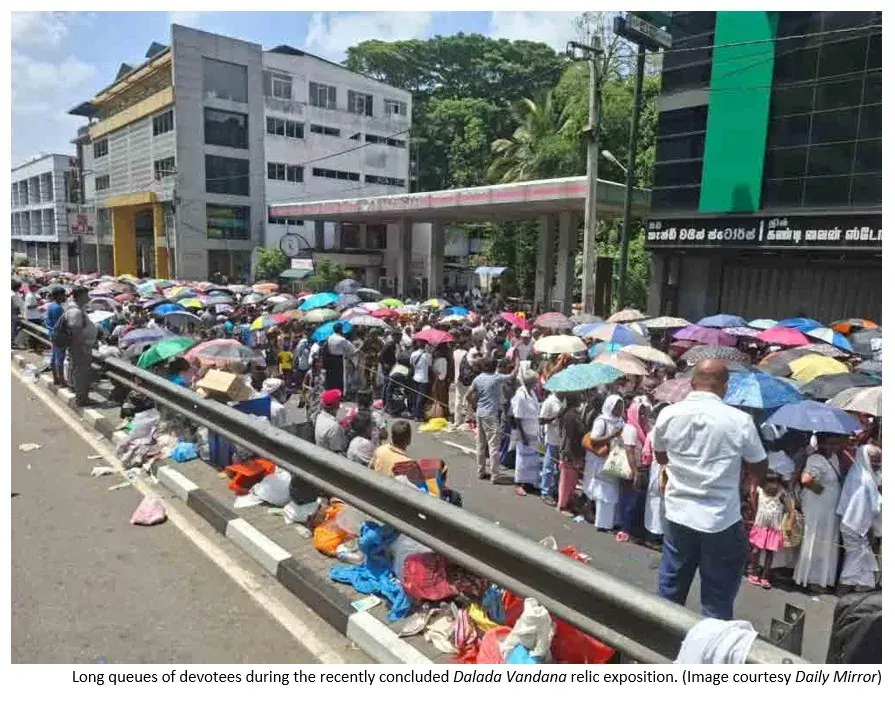
Hundreds of thousands of Buddhist devotees paid their homage to the sacred tooth relic for 10 days, and the government has called Siri Dalada Vandana a huge success. Will the NPP government receive any political mileage, intended or otherwise, from that mega religious event? Opinion is divided on this score.
The government is arguing that it has succeeded in debunking the Opposition’s claim, which received wide publicity during the past poll campaigns, that the election of a JVP-led government would spell doom for Buddhism, and other religions, given its Marxist outlook. JVP General Secretary Tilvin Silva himself has gone on record as saying that the government has given the lie to the Opposition’s claim that the NPP would not allow Buddhist religious ceremonies to be held.
The rivals of the government, however, are of the view that the NPP’s efforts to use the Kandy relic exposition to shore up its approval ratings ahead of an election have not only failed but also proved counterproductive. The event was characterized by widespread chaos owing to poor organization and lack of state assistance, they have claimed, pointing out that the sacred city of Kandy reeked of garbage and human waste, for 10 days, as the government had failed to provide adequate garbage disposal and sanitary facilities. They have compared Siri Dalada Vandana with the Dalada exposition held in 2009 under President Mahinda Rajapaksa’s presidency; the devotees did not face any hardships at that time, and all their needs were taken well care of in 2009 as the Rajapaksa government was capable of organizing such events, they have said. The SJB has claimed the NPP turned a holy event into an utter mess, and caused Kandy to stink. All Opposition parties, more or less agree, that the Kandy relic exposition was part of the NPP’s political strategy and the government’s efforts backfired.
Chances are that the tooth relic exposition, whatever mileage the government gained, or the negative aspects of the event the Opposition has chosen to highlight may not be a determining factor in the upcoming LG polls. Issues crop up at such a rate in this country that the public cannot keep track of them. If something big happens in the next few days, everybody will forget the Dalada exhibition.
The challenge before the NPP government is to convince the public that its rule has benefited them more than the previous ones, and justify its failure to fulfil most of its key election promises. The task before the Opposition, especially the SJB, is to prove its allegations against the NPP and present itself as a viable alternative capable of managing the economy, granting relief to the public and battling corruption in a different yet better way and win back popular support. If its claim that the government has botched governance and been exposed for ineptitude, has gone down with the public, it should be able to improve its performance in the upcoming elections.
RELATED NEWS
View all
Politics by Vishvanath
Has 22A become the govt.'s Catch-22?
Aug 27, 2026
Politics by Vishvanath
22nd Amendment: A huge political gamble for govt.
Aug 21, 2026
Politics by Vishvanath
Move to raise retirement ages of judges: Options before govt.
Aug 05, 2026
Politics by Vishvanath
‘Cockroach’ uprising and echoes of Aragalaya
Jul 26, 2026