Politics by Vishvanath
Rise in crime, ‘mini governments’ and executive presidency
By Vishvanath
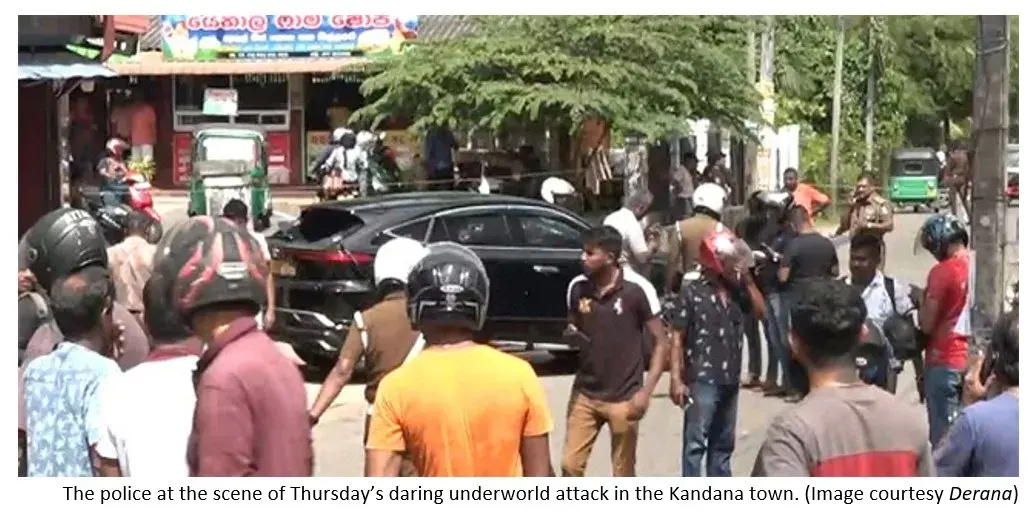
An increase in underworld killings, which are reported almost daily, has caused much concern not only to the public but also to the government, which came to power, vowing to restore the rule of law in just two months late last year. About 58 shooting incidents have claimed about 35 lives so far this year, and Minister of Health and Media Dr. Nalinda Jayatissa has said most of these killings have been over turf wars among drug dealers and other underworld characters. What is really at issue is not whether the killings are due to underworld rivalries but the fact that the law enforcement authorities have failed to stop them as well as the ability of criminal gangs to strike at will anywhere in the country.
The police have launched two high-profile search operations during the past few days, following two incidents of gun violence in the Gampaha District, last Thursday; in the Kandana town Sameera Manahara, a former Private Secretary to the late Minister Mangala Samaraweera, and his brother-in-law came under attack, which left Sameera seriously injured and the other dead. An ex-soldier was killed by two assassins at night on the same day elsewhere in the Gampaha District. The police including the STF were assisted by the Navy in the aforementioned search operations in that district. More than 300 suspects were taken into custody, according to the police. That was the government’s knee-jerk reaction to the upsurge in underworld activities.
Search operations launched after crimes are committed could be considered face-saving exercises rather than well-planned crackdowns based on proper intelligence gathering and analysis. Assassins working for organized criminal gangs do not stay in the areas where they carry out killings, and therefore it is an exercise in futility to cordon off those places several hours after violent incidents and deploy the police and the armed forces to hunt down the perpetrators. The previous government had such crackdowns conducted in an organized manner under the direct supervision of IGP Desabandu Tennakoon, who has been suspended over some serious allegations including abuse of power and a shooting incident in Weligama, where a policeman died. That anti-crime operation was named “Yukthiya” (Justice), and it came under severe criticism for police excesses and arbitrary arrests.
President Maithripala Sirisena (2015-2019) also launched a war on drugs. He drew criticism for police excesses and human rights violations. He went so far as to blame the 2019 Easter Sunday terror attacks on the criminal gangs affected by his war on drugs! Obviously, President Sirisena was planning to leverage the “success” of his anti-narcotic operation to garner favor with the people and shore up his chances of re-election. The Easter Sunday tragedy made his plan go pear-shaped so much so that he skipped the 2019 presidential election. The “Yukthiya” operation also did not benefit the SLPP-UNP government politically, as evident from the poor performance of the two parties in last year’s presidential and parliamentary election.
Security and executive presidency
One of the most compelling arguments for introducing the executive presidency here in 1978 was that the controlling apparatus (government) of a developing state had to be very strong to safeguard public/national security and usher in development expeditiously. Having secured the executive presidency, J. R. Jayewardene, echoing the apocryphal boast often attributed to Napoleon, declared that he was so powerful that the only thing he could not do was to make a man a woman. However, a few years later, he had to swallow his pride and say the people had to look after their own security, providing grist to the mill of the opponents of the executive presidency, prominent among them being the JVP. In 2022, President Gotabaya Rajapaksa had to head for the hills with angry mobs in close pursuit despite his presidential powers. However, there is a school of thought that it was the executive presidential powers that enabled President Mahinda Rajapaksa to provide political leadership for defeating the LTTE militarily in 2009. If so, the question is why his predecessors, numbering four—namely, Jayewardene, Ranasinghe Premadasa, D. B. Wijetunge, and Chandrika Bandaranaike Kumaratunga—had failed to win the war.
A little over 16 years on, President Anura Kumara Dissanayake, whose government has a bigger parliamentary majority than those of both Jayewardene and the Rajapaksas, has recently said at an official function that there are some ‘mini governments’ in the country and he will neutralize all of them. His reference has been mainly to powerful cartels in the commercial sector, defying government decisions and programs to grant relief to the public. Much is being spoken these days about the Rice Mafia and the Private Bus Mafia. Successive governments have been accused of playing soft ball with them. The emergence of these Mafias could be attributed to their financial prowess and political clout. However, it has demonstrated the growing impotence of the executive presidency and its failure to help the country achieve what it was introduced for.
The JVP has consistently campaigned against the executive presidency, and, during its presidential election campaign last year, it repeated its promise to do away with that powerful institution. One of the main conditions on which the JVP supported Mahinda Rajapaksa in his 2004 presidential election campaign was that he would abolish the executive presidency. Now, the JVP itself has secured the presidency and can do what it sought to have done through others like Mahinda and Chandrika Bandaranaike Kumaratunga. Deputy Minister of Public Security Sunil Watagala has admitted that the JVP-led NPP will be without any moral right to talk about another presidential election, much less contest it. However, overall, the government has chosen to remain silent on its pledge to abolish the executive presidency, for the JVP/NPP is heavily dependent on President Dissanayake, where elections are concerned, and therefore wants him to retain his executive powers. It has not carried out its pledge to draft a new Constitution as the first step towards the abolition of the executive presidency.
The NPP’s election pledge to draft a new Constitution would not be implemented until the local government and Provincial Council polls were over, the government informed the parliament on April 09, 2025. Prime Minister Dr. Harini Amarasuriya told the House that two elections had been held in the past six months, and another election was scheduled for May. She also noted that the Provincial Council elections had been due for several years. The process of drafting a new Constitution would begin soon after the elections to the provincial councils were held, she said in answer to a question raised by ITAK Batticaloa District MP Shanakiyan Rasamanickam. She claimed that when the government came to power last year, it had had to focus completely on stabilising the economy and safeguarding democracy by conducting the elections that had been delayed.
There are some attempts to revive the campaign for the abolition of the executive presidency and they are likely to gather momentum with the passage of time. It is already being asked in some quarters why the powerful executive presidency has failed to help resolve issues such as threats and challenges posed by the ‘mini governments’ that have undermined the writ of the state and the political authority. It will be interesting to see the JVP’s official response to calls for the abolition of the executive presidency before the next presidential election.
RELATED NEWS
View all
Politics by Vishvanath
Has 22A become the govt.'s Catch-22?
Aug 27, 2026
Politics by Vishvanath
22nd Amendment: A huge political gamble for govt.
Aug 21, 2026
Politics by Vishvanath
Move to raise retirement ages of judges: Options before govt.
Aug 05, 2026
Politics by Vishvanath
‘Cockroach’ uprising and echoes of Aragalaya
Jul 26, 2026